Showing posts with label poetry. Show all posts

Monday, March 20, 2017

an ode to the tax code


Ode to the Tax Code
by V. Patschke

There is hereby imposed
on the taxable income
of every individual
(other than a surviving spouse
as defined in section 2(a)
or the head of a household
as defined in section 2(b))
who is not a married individual
(as defined in section 7703)
a tax
determined in accordance
with the following table.

If your taxable income is:
not over $22,100
Your tax is:
15% of taxable income.
If your taxable income is:
Over $22,100
but not over $53,500
Your tax is $3,315
plus 28% of the excess
over $22,100.

If your taxable income is:
The spectrum of colors in the rainbow
Your tax is:
Indigo

If your taxable income is:
A 100-piece symphony orchestra
Your tax is:
Flutes and violins

If your taxable income is:
Geometry
Your tax is:
Triangles

If your taxable income is:
The gift of superpowers
Your tax is:
Invisibility

If your taxable income is:
A bountiful feast
followed by mouthwatering desserts
Your tax is:
Indigestion
followed by a period of fasting

If your taxable income is:
Eight hours of sleep
with lovely dreams
Your tax is:
Loud snoring
with two trips to the bathroom

If your taxable income is:
Unconditional love from family and friends
Your tax is:
Less frequent letters and
fewer phone calls

If your taxable income is:
Peace and prosperity
Your tax is:
A period of political chaos
and discontent

In applying rulings
and procedures
published herein,
the effect of subsequent
legislation,
regulations,
court decisions,
rulings, and
procedures must be
considered.
All taxes are due
on the 15th of April.
In the event of late payment
A 25% fee
and 25 grey hairs
will be applied.

Monday, January 16, 2017

so many elbows


Where I’m From
           a poem by Vicki Patschke

I’m from family 
A family of eight
Or eight times eight 
When you counted the heads
Of friends and visitors
And always the pets —
Dogs, cats, rabbits, 
guinea pig, hamster, mice
parakeets, turtles, snails
and one bow-legged duck

Our family of eight
Squeezed into cars
And crowded trains
Shoulder to shoulder
Elbow to elbow
Heart to heart

At happy crowded tables
We passed the potatoes
Helped with homework 
And dealt the cards

Instant friends
Instant foes 
Always racing
To finish first 
To claim the sofa
To claim the last bite

Always sharing 
Hand-me-downs
of used clothes 
of thumb-smeared books
of opinions and advice

Our family of eight
Now grown and scattered
With empty spaces between us
Separated by gaps
of time and place
of experiences
of philosophy

But wherever we turn
We will always be
From our family of eight
Shoulder to shoulder
Elbow to elbow
Heart to heart


Monday, February 1, 2016

there's something about grasshoppers

On the Grasshopper and Cricket    

by John Keats

The Poetry of earth is never dead:    
  When all the birds are faint with the hot sun,    
  And hide in cooling trees, a voice will run    
From hedge to hedge about the new-mown mead;    
That is the Grasshopper’s—he takes the lead      
  In summer luxury,—he has never done    
  With his delights; for when tired out with fun    
He rests at ease beneath some pleasant weed.    
The poetry of earth is ceasing never:    
  On a lone winter evening, when the frost     
    Has wrought a silence, from the stove there shrills    
The Cricket’s song, in warmth increasing ever,    
  And seems to one in drowsiness half lost,    
    The Grasshopper’s among some grassy hills.

Friday, June 13, 2014

the bird, the bell, and me (misuzu kaneko series #5)

The Bird, The Bell, And Me
by Misuzu Kaneko
translated and illustrated by dosankodebbie

Though I hold out my arms as wide as I can,
I can never soar the skies;
A little bird can do just that,
yet not run as fast as I can.

Though I jiggle my body from head to toe,
I can't make pretty sounds;
A tinkling bell can do just that,
yet not know as many songs as I do.

The bell, the bird, and then there's me;
each of us different, and each of us good.

Sunday, November 4, 2012

the mole and the earthworm

A Handy Mole 
Christina Rossetti (1830 - 1894)

A handy Mole who plied no shovel
To excavate his vaulted hovel,
While hard at work met in mid-furrow
An Earthworm boring out his burrow.
Our Mole had dined and must grow thinner
Before he gulped a second dinner,
And on no other terms cared he
To meet a worm of low degree.
The Mole turned on his blindest eye
Passing that base mechanic by;
The Worm entrenched in actual blindness
Ignored or kindness or unkindness;
Each wrought his own exclusive tunnel
To reach his own exclusive funnel.

A plough its flawless track pursuing
Involved them in one common ruin.
Where now the mine and countermine,
The dined-on and the one to dine?
The impartial ploughshare of extinction
Annulled them all without distinction.

Thursday, August 2, 2012

the blue period

Fog Cat

 I can't remember when blue wasn't my absolutely favorite color. And blue goes so well with poetry, don't you think?

The first two etegami posted here were experiments with watercolor inks and watercolor paper--materials I am not at all familiar with, as strange as that may sound to you. They are rare examples of the image coming to me before the words do. But as soon as I finished painting the cat, I just knew that it was the Fog Cat from the Carl Sandburg poem Fog.

Blue Pigeon


The words quoted on the blue pigeon etegami are from the poem Japanese Lullaby by Eugene Field.


Santoka's Owl
The barred owl was done in the traditional etegami manner, with my trusty and true sumi ink, gansai paints, and washi paper, as suits the classic Taneda Santoka haiku. All the originals are for sale on my Etsy shop.

Friday, July 20, 2012

fan-shaped etegami

Blueberries with a Robert Frost quote

Banana with a Groucho Marx quote

Ayu (sweetfish trout) with a haiku by Buson
I painted these etegami on fan-shaped washi cards and inserted them into "frames" that I made by gluing pretty paper onto stiff, rectangular cards cut out of file folders or cookie boxes.

These etegami could be removed from the frames and replaced with other  etegami in the same shape. You could use one frame for a whole pack of fan-shaped etegami if you made the frame a neutral color. Then you could change the etegami once a month, or at least once a season. What do you think?

Sunday, March 11, 2012

the moon

spring (inspired by Psalm 89:37)

winter (inspired by the poem by Misuzu Kaneko)

autumn (inspired by the haiku by Matsuo Basho)

Friday, March 9, 2012

illustration friday (yield)


Reluctance

by Robert Frost

Out through the fields and the woods
And over the walls I have wended;
I have climbed the hills of view
And looked at the world and descended;
I have come by the highway home,
And lo, it is ended.

The leaves are all dead on the ground,
Save those that the oak is keeping
To ravel them one by one
And let them go scraping and creeping
Out over the crusted snow,
When others are sleeping.

And the dead leaves lie huddled and still,
No longer blown hither and thither;
The last lone aster is gone;
The flowers of the witch-hazel wither;
The heart is still aching to seek,
But the feet question 'Whither?'

Ah, when to the heart of man
Was it ever less than a treason
To go with the drift of things,
To yield with a grace to reason,

And bow and accept the end
Of a love or a season?

Saturday, September 24, 2011

more cats


Lately I've noticed that I am surrounded by people who are passionate about cats. I had to muffle my own childhood affection for cats for the sake of my husband and kids, all of whom have serious asthma and cat allergies.

But under the influence of the aforementioned cat fanatics, my old affections are stirring again. Well, I don't think etegami ever gave anyone an asthma attack, so these days I'm expressing that affection more and more in cat paintings. The last two are the latest additions to my Eliot's Cats series which gets its inspiration from Old Possum's Book of Practical Cats by T.S.Eliot, the basis for the musical CATS.


Monday, September 12, 2011

illustration friday (boundaries)


Mending Wall has always been one of my favorite poems by Robert Frost, not only for the debate it provokes within me about walls and boundaries, but also for the humor in it.

Whenever I read the part about apple trees and pine cones, I picture a pine cone version of a horror movie in which apples go after the pine cones with a crazy hunger in their eyes and sharp, flashing teeth.

For this week's Illustration Friday, I only had time to throw together a collage using bits and pieces of etegami I've painted in the past. Mending Wall has so many other delicious lines that I'd like to use in etegami some day. Here are some more that I'm just itching to quote:

Before I built a wall I'd ask to know
What I was walling in or walling out,
And to whom I was like to give offence.


Saturday, August 27, 2011

ice and claws (north seas series)

A polar bear walks gingerly across the ice. The accompanying words quote from the last stanza of the poem Arktos by Ari Berk:

Wind of knives and fury born of stars
May not deter a giant built of ice and claws
Unless the sleep of solstices be on him
He, Son of Sedna and the Northern Waste


Saturday, June 25, 2011

illustration friday (midsummer night)


Midsummer Night Itch

by N. M. Bodecker

Mosquito is out,
it’s the end of the day;
she’s humming and hunting
her evening away.
Who knows why such hunger
arrives on such wings
at sundown? I guess
it’s the nature of things.

(this poem is in the public domain)


Thursday, June 9, 2011

dewdrops (misuzu kaneko series #3)


Dewdrops
I will keep it to myself
that the flowers were shedding tears
in a corner of the garden
this morning.

If the news were to spread,
and the bees were to hear of it,
they would feel so guilty,
they might return the honey.

my translation

Monday, June 6, 2011

sweet osmanthus (misuzu kaneko series #2)


Sweet Osmanthus
The sweet fragrance of osmanthus
fills the garden.
The breezes hesitate
at the gate,
debating whether or not to enter.

my translation

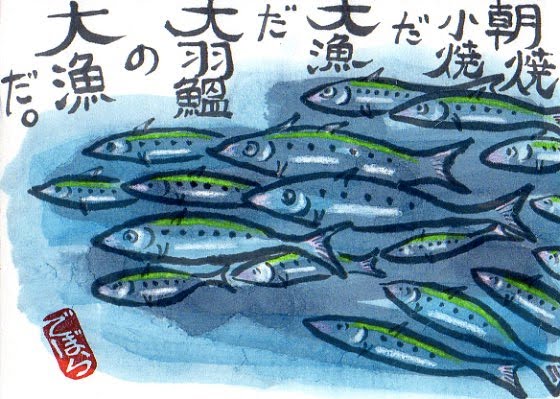
the big haul (misuzu kaneko series #1)


I recently became a fan of poet and songwriter Misuzu Kaneko. I had long been aware of her poems for children, but until recently I had never wondered about the poet herself. Now that I know more about her, I am hit harder and more deeply by her works than I was before.

Like the butterfly in the previous post, this was painted on a double-sized washi card that I've been experimenting with lately. It doesn't have the same bleed factor as my usual brand, but I'm trying to learn how to use it to its full potential.

I've tried to translate the short poem that inspired today's etegami, but I haven't been able to capture the rhythm of the Japanese words, or convey the unsentimental pathos of the original. I will keep working on it. But the meaning goes something like this:

The Big Haul
Beneath a glowing sunrise,
the fishing boats return,
loaded with Ooba Sardines.
On shore, villagers celebrate like it's a festival.
In the sea, sardines hold a funeral
for their tens of thousands of mates.


Saturday, April 23, 2011

illustration friday (bicycle)

This etegami was inspired by real life experience (lol), and the Shel Silverstein book-length poem The Missing Piece, part of which goes like this:

It was missing a piece.
And it was not happy.
So it set off in search
of its missing piece.
And as it rolled
it sang this song -
Oh I'm lookin' for my missin' piece
I'm lookin' for my missin' piece
Hi-dee-ho, here I go,
Lookin' for my missin' piece.


[Note: I'm curious about whether bicycles are sold with little locks on the front wheel in your country, as they are in Japan. When I googled bicycle locks, all I could find on the English language sites were chains that lock. We buy locking chains for extra protection if we want, but our bikes always come with a small lightweight boxy lock on the front wheel. The key that I drew is the kind of key that comes with that boxy lock.]


Friday, April 8, 2011

illustration friday (bottled)

The inspiration for this etegami comes from a silly poem titled "An Alphabet," by the great English nonsense poet Edward Lear (1812 – 1888). I'm always looking for excuses to paint with blue, which happens to be my very favorite color. What's yours?

Tuesday, March 15, 2011

humanizing the quake (iwate)


The Iwate-born writer Kenji Miyazawa (1896-1933) is the author of some of the most beloved children's stories and free-verse poetry of Japan. One of my favorites is the poem known as Ame ni mo makezu (literally: "undefeated by the rain"). I tried to express some of the poem's sentiments in this etegami of a broken umbrella.

I trust that the survivors of the Great Tohoku Earthquake, as inheritors of Miyazawa's legacy, will be drawing deeply from the well of human character described in this poem, as they rebuild their lives in the aftermath of disaster.

Be Not Defeated by the Rain
Written by Kenji Miyazawa and Translated by David Sulz

Be not defeated by the rain, Nor let the wind prove your better. Succumb not to the snows of winter. Nor be bested by the heat of summer.

Be strong in body. Unfettered by desire. Not enticed to anger. Cultivate a quiet joy.
Count yourself last in everything. Put others before you. Watch well and listen closely. Hold the learned lessons dear.

A thatch-roof house, in a meadow, nestled in a pine grove's shade. A handful of rice, some miso, and a few vegetables to suffice for the day.

If, to the East, a child lies sick: Go forth and nurse him to health.
If, to the West, an old lady stands exhausted: Go forth, and relieve her of burden.
If, to the South, a man lies dying: Go forth with words of courage to dispel his fear.
If, to the North, an argument or fight ensues:
Go forth and beg them stop such a waste of effort and of spirit.

In times of drought, shed tears of sympathy. In summers cold, walk in concern and empathy.

Stand aloof of the unknowing masses: Better dismissed as useless than flattered as a "Great Man".

This is my goal, the person I strive to become.

(here is an alternate translation)