Aomori prefecture is as far north as you can go on the main island of Honshu, and is separated by the Tsugaru Straits from my own homeland of Hokkaido, which is the furthest north you can go in Japan. One of the popular souvenirs that people bring home from their travels to Aomori is the
Hato-bue (pigeon whistle). Actually, the word for pigeon and the word for dove are the same in Japanese, so you could also call them "dove whistles."
These roughly pigeon/dove-shaped, baked-clay tweeters go back to the Edo period (1600-1868), when, it is said, they were given to children as noisy toys in the belief that the racket would protect them from evil spirits.
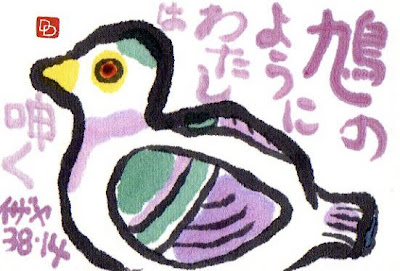
A hato-bue has a hollow center with a sounding slit on its belly and a tail that serves as a mouthpiece. The traditional ones are painted in pastel tones of purple, green, and pink.
In a fit of experimentation, I painted the words with a painting brush and gansai paint, rather than the usual writing brush and sumi ink. It gives a fuzzy, vague feeling to the whole etegami. The writing translates to:
I moan like a dove, and is part of a heart-wrenching cry for help in oppressed circumstances. (See the rest of the passage in
Isaiah 38:14-16).


 Posts
Posts