Showing posts with label haiku. Show all posts

Thursday, May 28, 2015

rainy season haiku


While Hokkaido looks forward eagerly to a typically mild, sunny, fragrant, bright green, sweet-breezy June, the rest of Japan has entered-- or is about to enter-- the pre-summer rainy season called tsuyu, often translated literally as "plum rains."

The mugginess of tsuyu can be quite miserable-- one of those times of the year when I wonder out loud how anyone would choose to live anywhere other than tsuyu-less Hokkaido. (In just a few months, the Hokkaido winter will arrive with a powerful reply to that question.)

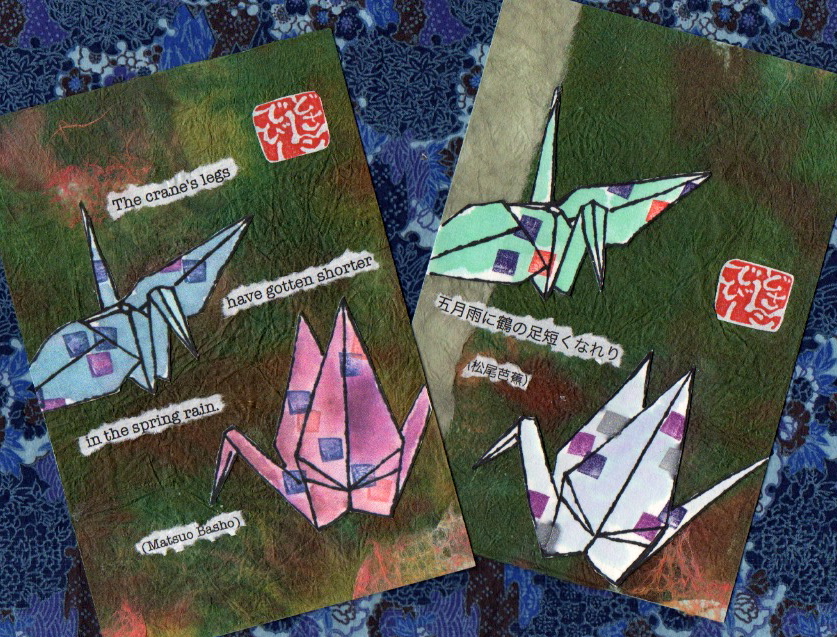
Well, anyway, I've been working on tsuyu-related etegami to encourage my friends who have to endure the rainy season. I started with a couple of etegami collages that recombine parts of previous etegami that may seem familiar to you.

Both the Japanese version and the English version quote a gently humorous haiku by Matsuo Basho: The crane's legs/have gotten shorter/in the spring rain (translated by Robert Hass). It's easy to imagine the cranes standing in the water, their long, skinny legs appearing shorter and shorter, as the level of the river, stream or lake rises higher and higher. The folded paper cranes, being legless, are kind of perfect for this haiku, don't you think?


Wednesday, April 3, 2013

uneaten ducks

Issa's haiku are so down-to-earth. Spring makes me glad to be alive- to have survived winter- just like the uneaten ducks.

Friday, August 31, 2012

illustration friday (identical)

Some of you may have seen this etegami before. I considered it a "failure" when I first painted it, but it grew on me with the passing of time, and now it's one of my favorites. The accompanying words are a haiku by the wandering poet Matsuo Basho (1644-1694). Don't imitate me. It's as boring as two halves of a melon.

Wednesday, August 15, 2012

meteor shower

Most poetry baffles me, but this haiku by Juliet Wilson, blogger at Crafty Green Poet, struck an inner chord. It made me think of all the enthusiasm the media drummed up this year over various cosmic phenomena for which much of Japan was supposed to have front-row seats. Our particular piece of the sky was clouded over every time.

a week of foxes

Inspired by The Little Prince by Antoine de Saint-Exupery

origin of quote unclear
Inspired by the Japanese children's song "Ko-Gitsune" (Little Fox)

Inspired by the Japanese children's song "Kita-Kitsune" (Northern fox)

Inspired by "Friends, Lovers, Chocolate" by Alexander McCall Smith

Inspired by the folksong "The Fox" which my mother sang to me when I was little.

A spring festival fox mask with a Kobayashi Issa haiku

Monday, August 6, 2012

illustration friday (bounce)

In Issa's haiku, Kasa often refers to the headgear sometimes translated as "umbrella hats." But here, I chose to interpret kasa to mean the traditional, bamboo-framed umbrellas that were covered in waxed paper. I'm sure many of you have seen one, or even bought one as a souvenir. They are also called wa-gasa (Japanese umbrellas) nowadays to differentiate them from modern, western-style umbrellas. I love the sound of rain bouncing against a wa-gasa. And I can easily imagine how my heart would jump if a camellia blossom ever plopped onto one while I was inside it.

Friday, July 20, 2012

fan-shaped etegami

Blueberries with a Robert Frost quote

Banana with a Groucho Marx quote

Ayu (sweetfish trout) with a haiku by Buson
I painted these etegami on fan-shaped washi cards and inserted them into "frames" that I made by gluing pretty paper onto stiff, rectangular cards cut out of file folders or cookie boxes.

These etegami could be removed from the frames and replaced with other  etegami in the same shape. You could use one frame for a whole pack of fan-shaped etegami if you made the frame a neutral color. Then you could change the etegami once a month, or at least once a season. What do you think?

Monday, March 7, 2011

two halves of a melon


This is a second etegami I did for Illustration Friday on the theme of "warning." The accompanying words are a haiku by the wandering poet Matsuo Basho (1644-1694). The English version I used for this piece is Robert Haas's translation. Don't imitate me. It's as boring as two halves of a melon.

Thursday, September 23, 2010

issa's cows


Haiku inspires many of my etegami. The poems of Matsuo Basho are favorites of mine. But he doesn't mention cows very much, and after my recent purple cow post, I was itching to draw more cows. You know who mentions cows time and time again? The haiku poet Kobayashi Issa. This fact was recently brought to my attention by @Cow Lady when she sent me this link. I took up the challenge and, although I didn't necessarily use the translations provided on that page, I tried my hand at illustrating some of Issa's cow haiku with etegami collages.


In my next post, I'll show you some etegami I did that were inspired by cow proverbs. heh heh. Can you tell I'm having fun?

Thursday, July 1, 2010

inspired by haiku again


Yes... I know dragonflies aren't in season quite yet, at least not where I live. But I just adore their shape, their design. Don't you? I love the fact that they swoop into our yard in the late summer, early fall, and gobble up all the mosquitoes. Don't you? I love how dragonflies inspired so many of Kobayashi Issa's haiku. Don't you?

Monday, January 11, 2010

inspired by haiku


My etegami are often accompanied by fragments of poetry. No, not my own. Poetry that other people have written. Sometimes the drawing will bring a poem to mind. Other times a poem I've read or heard will compel me to express it in etegami. This is especially true of haiku poetry, and even more true of the haiku of Matsuo Basho (1644-1694), the internationally renowned wandering poet of Japan. When I drew this closeup of a single white flower, it was his haiku on the sound of the temple bell that came to mind. Maybe the numerous yellow stamens reminded me of the knob-ended sticks that are used for hitting some kinds of gongs or temple bells. Whatever it was that went through my subconscious thoughts, the simplicity of the image and the simplicity of haiku seemed to be a perfect match. Try pairing an etegami drawing with one of your favorite haiku, or compose one of your own for the purpose.