Showing posts with label cranes. Show all posts
Thursday, May 28, 2015
rainy season haiku
While Hokkaido looks forward eagerly to a typically mild, sunny, fragrant, bright green, sweet-breezy June, the rest of Japan has entered-- or is about to enter-- the pre-summer rainy season called tsuyu, often translated literally as "plum rains."
The mugginess of tsuyu can be quite miserable-- one of those times of the year when I wonder out loud how anyone would choose to live anywhere other than tsuyu-less Hokkaido. (In just a few months, the Hokkaido winter will arrive with a powerful reply to that question.)
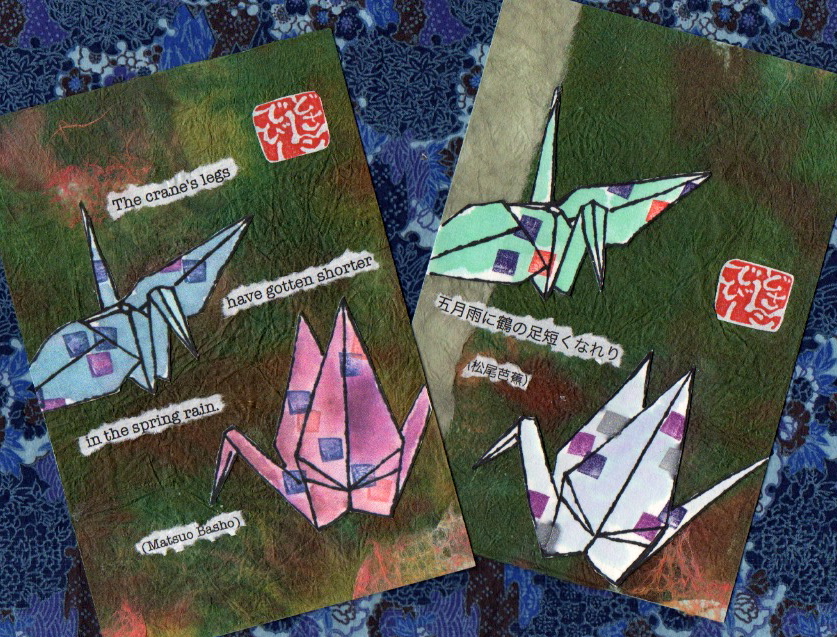
Well, anyway, I've been working on tsuyu-related etegami to encourage my friends who have to endure the rainy season. I started with a couple of etegami collages that recombine parts of previous etegami that may seem familiar to you.
Both the Japanese version and the English version quote a gently humorous haiku by Matsuo Basho: The crane's legs/have gotten shorter/in the spring rain (translated by Robert Hass). It's easy to imagine the cranes standing in the water, their long, skinny legs appearing shorter and shorter, as the level of the river, stream or lake rises higher and higher. The folded paper cranes, being legless, are kind of perfect for this haiku, don't you think?
Wednesday, April 15, 2015
wishes and prayers and paper cranes
Of the dozens and dozens of origami (the Japanese art of paper folding) models I used to amuse myself with as a child, the only one I make time for with any regularity these days is the paper crane. This is because of what the crane symbolizes and the role of paper cranes in many aspects of Japanese life even now. Cranes can represent long life, fidelity, happiness, prosperity, health, healing and peace. They are a part of Japanese legend, and folded paper cranes are often used as charms for making wishes come true.
Friends and family may cooperate to fold one thousand small paper cranes and string them together to celebrate happy occasions such as a wedding or the birth of a child. In this form they are called senbazuru. Senbazuru are also made for the sick, with wishes for healing; and offered to the spirits of those killed in accidents or in times of war, as a prayer for peace.
Although I don't believe paper cranes have any power to grant wishes, I am drawn to the sentiments they represent. So I fold them or I paint them, and I give them to people who understand without my saying so that I hold them in my heart and in my prayers.
Subscribe to:
Posts (Atom)