Thursday, July 29, 2010

buying etegami materials online


So many of you have asked for advice on where the tools and paper for etegami can be purchased. Several of you have suggested promising websites. But so far, the only cardstock I've found that is produced specifically for etegami, and that can be ordered online from the US, is on the JetPens website. Thanks, Cole for being the first to direct me to this page! Etegami cardstock is usually labeled gasenshi, wagasenshi, or hongasenshi. Packages of these cards usually come with some sort of indicator of nijimi quality (which allows ink to bleed/spread sideways).

I prefer cardstock with the highest level of nijimi. The cards shown on the JetPens website have a scale of nijimi printed on the package. The placement of the circle in the row of boxes indicates the nijimi level, and the further left that circle is, the greater the nijimi. The attached photo (top) shows the set of cards that has the highest nijimi level on the JetPens page. This would be my choice. However, cards with high nijimi can be difficult for beginners to handle, so you may want to order cards of varying nijimi levels and test them till you find the one you're most comfortable with.

The JetPens website also offers a set of gansai paints (middle photo). They call it "Akashiya watercolor paints," but the box itself says Gansai on it in Japanese characters, so I feel safe in recommending it as the same type of paints I use. I was unable to find the kind of brush pens or sumi ink I use on this site. They do have some kind of brush pens, but they seem different from the ones we use for etegami.

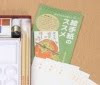
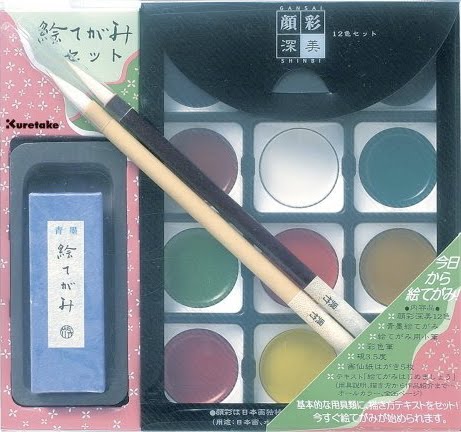
I've ordered several etegami sets from Amazon JP, just to test them, and I like one well enough to recommend to you, but Amazon JP will not ship the item (see bottom photo) to overseas addresses. It comes with everything you need to start etegami, including a brush pen for outlines, a different kind of brush pen for coloring, an ink stick for making sumi ink, and a booklet introducing the art of etegami (in Japanese, with lots of pictures). The only complaint I have about this set is that the sample postcards included with it do not have much nijimi.

I emailed Kuretake (JP), the company that makes this etegami set, asking for leads to online shops. They kindly responded almost immediately, but could only give me the names and numbers of one US-based art supply store and one UK-based art supply store which carry Kuretake products. If you live within the telephone area code of the following businesses, it may be worth your while to call them. You can also contact them by email. Apparently, Kuretake (JP) has already informed them of my search, so they should be prepared to help you.

Company name: KURETAKE (U.K.) LTD.
Tel: +44-1527-523-799
Contact: Ms. Samantha Deykin

Company name: FLAX art & design
Tel: +1-415-552-2355
Contact: Mr. Philip Flax

Sunday, July 25, 2010

illustration friday (double)


I love drawing persimmons at any stage: Seeds, flowers, unripe fruit, ripe fruit, over-ripe fruit, sliced, quartered, dried and wrinkled, on the branch, on the ground, tied to drying ropes and hanging from the eaves, piled in a bowl, bug-eaten... and so on. For this week's IF topic, I present you with an etegami of two nearly identical persimmons that ripened on the branch late last fall/early winter as I watched and marveled. The words say: In the Fullness of Time.

Friday, July 23, 2010

hydrangea etegami garden


Remember the etegami tulip mini-exhibit I posted in May? I promised you a hydrangea etegami exhibit in mid-summer, and here it is. Hydrangea are generally considered much harder to draw than tulips. Even so, I was able to persuade a few new people to contribute, so we have a nice diversity of style and materials for this exhibit. Maybe they will motivate more of you to contribute to the next one. How about mid-autumn, on the topic of Cosmos flowers? I'll get back to you about this as the time approaches.

Contributing artists (from the top grouping, starting at top left corner and moving clockwise):
1. Ogawa Yoko, dosankodebbie, dosankodebbie, Nakagawa Ryoko
2. Nakagawa Ryoko, Shimizu Michiko, dosankodebbie (haiku contributed for this exhibit by Aki Gibbons), Kushida Yukio
3. dosankodebbie, (haiku contributed for this exhibit by Aki Gibbons) Shimizu Michiko, dosankodebbie
4. Linda Austin, dosankodebbie, Shimizu Michiko
5. Nakamura Takako

Wednesday, July 21, 2010

tamano "sea-themed etegami" call (part 2)


Remember my post about the Sea-themed etegami call taking place this summer in the city of Tamano, Okayama? This etegami depicting a hatchling turtle is the one I decided to send. It's actually one I intended for the Ripple series but never got around to finishing. So I added Japanese words that basically mean "Please don't pollute our ocean," signed my name and prefecture at the bottom (as per instructions), and sent it off today. I think the Tamano etegami call is supposed to be a Feel-Good kind of event, so my contribution may not quite fit. But at least I remembered to send something at all. : )

Sunday, July 18, 2010

illustration friday (breakfast)


Last week a good friend of mine brought me a whole bunch of free-range, organic eggs and summer vegetables from her garden. I was trying to come up with a good theme for a thank-you card, when this week's IF topic was announced. What I decided to draw was a traditional Japanese breakfast. A porcelain bowl of steaming rice with a raw egg on top and a ceramic dish of pickles (mini-eggplants, daikon radish slices, and radish greens). I'm sending this off to my friend today. The accompanying words say "a Japanese breakfast."

Sunday, July 11, 2010

illustration friday (diary)


This week's IF topic brings to mind the series of etegami that I did to record the growth of my strawberry plant last year.

1: The day the strawberry seedling arrived at my house.
2: The day temperatures plummeted and I thought I had lost my plant to frostbite.
3: The day my plant revived and began to grow vigorously.
4. The day I noticed the first sign of fruit.
5: The day I harvested the first ripe strawberry.
6: The day I used the first strawberry as a filling for Ichigo Daiguku, a delicious, traditional Japanese confection.

The original post is here: My Strawberry Diary.

Friday, July 9, 2010

they draw and cook


If you have been visiting this blog for a while, you probably know how much I love to cook. I used to teach cooking to Japanese children from K to Grade 3, and thoroughly enjoyed illustrating my recipes for them.

A couple of months ago, I learned of this really cool website: They Draw & Cook that was posting "recipe renderings by artists, illustrators & designers," and I was raring to participate. But being somewhat technologically challenged, it took me a while to figure out how to follow the submission instructions.

I never did get the dimensions exactly right, but I guess I was close enough, and my illustrated recipe for Crunchy Ramen Salad Cones was posted several days ago. If you have time, take a look at some of the other submissions. They are absolutely awesome.