Showing posts with label summer. Show all posts

Wednesday, August 2, 2017

stamp people (the sparkler)


In Japan, August is the month for school vacation, cool cotton kimonos called yukata, hand-held flat fans called uchiwa, honoring deceased ancestors, telling ghost stories, and community festivals with folk dancing and firework displays. 

I've always been partial to the hand-held sparklers called senkou-hanabi (incense sparklers) myself. When the sparkling ball at the end of the thin stick dulls and plops to the ground, we are reminded that summer (like life) does not last forever. Which is the sort of bitter-sweet, melancholic symbolism that delights the Japanese soul. 

The writing on this Stamp People collage is in Japanese, and translates to: "When You Sparkle The World Sparkles With You." You can see that I tried to hide the hands on the postage stamp by adding hair. But it doesn't quite work. Cute stamp though, isn't it?

Wednesday, June 18, 2014

sunbeams

Inspired by the Showa era goldfish vending stalls. These were most often set up along the approaches to local shrines and temples with dozens of other specialty stalls that enlivened summer festivals in Japan (and still do). Back then, the glass globes (miniature goldfish bowls) hung from bamboo slats under the eaves of the stall-- a prop to make customers feel cooler in the sultry evenings of high summer, I think.

Other goldfish are sold from tanks set on the ground, and children pay for a chance to scoop them up with plastic-framed paper scoops that usually get soggy and tear before they can catch any fish. So they pay for another scoop. And another. As long as the coins that are clutched in their sweaty little palms last.

Thursday, June 12, 2014

more etegami uchiwa (bamboo flat fans)


I'm almost ready for summer! (ps: I fixed the misspelling on the clover fan after I took this photo. embarrassed.)

Tuesday, September 4, 2012

glorious summer vegetables

cucumbers

tomatoes

more tomatoes

eggplants

goya (bitter melon)

kabocha (Japanese pumpkin, top) and misc. veggies

corn on the cob

legumes (top) bell peppers (bottom)
In honor of summer's end, I selected some charming examples of traditional etegami from the pages of the September issue of Gekkan Etegami (the Japan Etegami Society's official magazine). These were painted and submitted by Society members throughout this summer.  I, as you know, spent most of the summer experimenting with new inks and painting styles. But when I saw these pictures, I fell in love all over again with good old traditional etegami.

Thursday, July 14, 2011

light conversation


I just had to paint this today, after watching a documentary this morning about lightning bugs and how they communicate with each other. :p

Friday, July 1, 2011

fun with starfish


The beach no longer plays a part in my summers, but it certainly did when I was a child, and that mental connection seems to be permanent. Starfish, jellyfish, and shellfish keep popping up in my latest artwork.

This week, the fascinating shapes, colors, and "postures" of starfish inspired some humorous etegami.

Saturday, June 25, 2011

Wednesday, September 1, 2010

video clip of summer etegami

I found this video clip of summer-themed etegami on YouTube posted by guu8211. I assume this person is also the artist, but the works themselves are signed with the mark for "se," which, according to etegami tradition, indicates that the artist's personal name probably begins with that syllable. (If I ever find out the full name, I'll let you know.) Since I want you all to be exposed to as many different etegami styles and personalities as possible, I've posted it here for you to enjoy:

Friday, August 6, 2010

illustration friday (caged)


Since ancient times, it has been the custom in Japan to seek respite from the heat of late summer and early fall by listening to the tinkling song of Suzumushi (Homoeogryllus japonicus), or Bell Crickets. I don't know how many people in the 21st century still enjoy this practice, but I fairly soaked myself in the silvery sounds one summer when my son and I raised bell crickets from eggs as a science experiment. Traditionally these creatures are kept in bamboo cages, though nowadays plastic cases are more common. It's like having a music box in your house that can't be turned off.

The accompanying words are a Japanese saying that translates roughly to: "the suzumushi is kept in a cage because of its song." The idea it conveys is this: One's own talents are sometimes the cause of one's misery. Kind of sad, isn't it.

As I was in an experimental mood, I drew this etegami with a Pelikan-brand fountain pen filled with blue-black ink. I waited for the ink to dry completely before adding the gansai paint, but (as I feared it would) the fountain pen ink smeared as soon as it got wet. That's okay, though. Like I'm always saying, the best etegami is that which you don't have complete control over.

Wednesday, August 4, 2010

frost berries


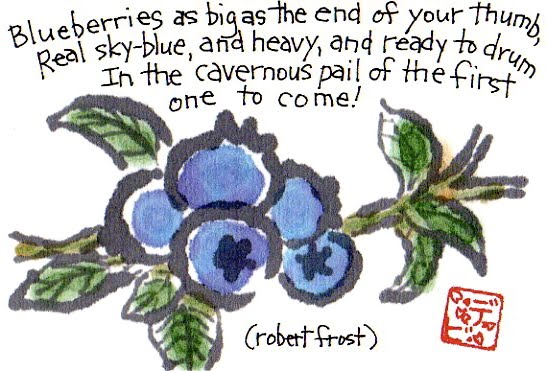
I enjoy many different kinds of fruit, but NOTHING beats berries. Here are three of my favorite berries in Etegami form. I drew the top one (blueberries) with a brush pen, and the lower two (blackberries and raspberries) with a bamboo quill pen. The accompanying words are all quotes from the same Robert Frost poem titled "Blueberries."

tsuyu-kusa (asiatic dayflower)


On hot summer days, the color blue can be so soothing. I picked a few stalks of tsuyu-kusa from our yard to draw for this very reason. The flowers are actually tiny. But close observation reveals how detailed they are, and in trying to capture that detail, I ended up drawing the flowers as though they had been magnified. A literal translation of the name of this plant is "dew grass." It brought to mind (especially in this heat) a verse from the book of Job: They waited for me as for the rain (29:23). I used a bamboo quill pen for the border of the image and for the words. I think the irregularities make the lines look almost as though they were formed from little drops of water.

Friday, July 23, 2010

hydrangea etegami garden


Remember the etegami tulip mini-exhibit I posted in May? I promised you a hydrangea etegami exhibit in mid-summer, and here it is. Hydrangea are generally considered much harder to draw than tulips. Even so, I was able to persuade a few new people to contribute, so we have a nice diversity of style and materials for this exhibit. Maybe they will motivate more of you to contribute to the next one. How about mid-autumn, on the topic of Cosmos flowers? I'll get back to you about this as the time approaches.

Contributing artists (from the top grouping, starting at top left corner and moving clockwise):
1. Ogawa Yoko, dosankodebbie, dosankodebbie, Nakagawa Ryoko
2. Nakagawa Ryoko, Shimizu Michiko, dosankodebbie (haiku contributed for this exhibit by Aki Gibbons), Kushida Yukio
3. dosankodebbie, (haiku contributed for this exhibit by Aki Gibbons) Shimizu Michiko, dosankodebbie
4. Linda Austin, dosankodebbie, Shimizu Michiko
5. Nakamura Takako

Monday, July 5, 2010

beetles and summer memories


If you grow up in Japan, and especially if you are a boy (which I am not, but I have raised one, so I know), summer vacation means beetle-catching time. Though I am not fond of creepy crawlies, for some inexplicable reason, beetles are okay with me.

I think it's safe to say that the most popular beetles among children here are the kabutomushi (rhinoceros beetle) and the kuwagata (stag beetle). We have been known, however, to spend our summers trying to capture semi (cicadas), or raising suzumushi (bell crickets) from eggs for a science experiment. Unlike the normally silent rhino beetles and stag beetles, cicadas and bell crickets hum, sing, buzz, and ring like silver bells. These sounds, along with the chants of the traveling wind-chime vendor or the pet goldfish vendor, will instantly awaken long-dormant childhood memories of summer.

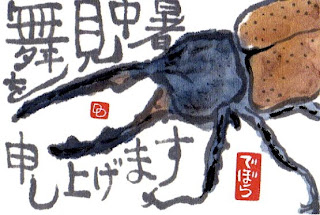
The etegami at the top depicts a Hercules Beetle, which is supposed to be the largest of the rhinoceros beetles. I drew it while I was experimenting with this week's Illustration Friday topic: Giant. My official IF submission ended up being the giant toad in my previous post. But I'm rather fond of this rhino beetle etegami, and I decided to use it for our 2010 summer greeting card. The accompanying words are the standard ones we use for this customary exchange: Shochuu mimai o moushi-agemasu (solicitations in the middle of summer's heat).

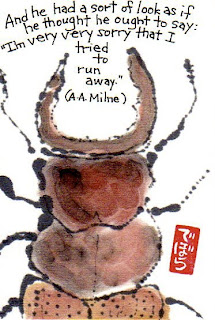
The second etegami depicts a stag beetle. The accompanying words are a short quote from a delightful AA Milne (of Winnie the Pooh fame) poem that I ran across the other day. I just can't resist posting the entire poem here. (I just can't!) I hope you enjoy it as much as I do.

Forgiven

I found a little beetle, so that beetle was his name,
And I called him Alexander and he answered just the same.
I put him in a matchbox, and I kept him all the day...

And Nanny let my beetle out
Yes, Nanny let my beetle out
She went and let my beetle out-
And beetle ran away.

She said she didn't mean it, and I never said she did,
She said she wanted matches, and she just took off the lid
She said that she was sorry, but it's difficult to catch
An excited sort of beetle you've mistaken for a match.

She said that she was sorry, and I really mustn't mind
As there's lots and lots of beetles which she's certain we could find
If we looked about the garden for the holes where beetles hid-
And we'd get another matchbox, and write BEETLE on the lid.

We went to all the places which a beetle might be near,
And we made the sort of noises which a beetle likes to hear,
And I saw a kind of something, and I gave a sort of shout:
"A beetle-house and Alexander Beetle coming out!"

It was Alexander Beetle I'm as certain as can be
And he had a sort of look as if he thought it might be ME,
And he had a kind of look as if he thought he ought to say:
"I'm very, very sorry that I tried to run away."

And Nanny's very sorry too, for you-know-what-she-did,
And she's writing ALEXANDER very blackly on the lid,
So Nan and me are friends, because it's difficult to catch
An excited Alexander you've mistaken for a match.

AA Milne


Monday, August 17, 2009

etegami and the heat of summer


When the rainy season ends, making way for the intense heat of mid-summer, the Japanese customarily send out a special kind of greeting card called the shochuu mimai to ask after the health of their acquaintances. Like the New Years greeting known as nengajou, it is a postcard, and is sent primarily to friends and family members that one doesn't see very often. Sometimes they are unadorned cards printed with the standard phrase, but more often they depict photographs or drawings of something representing summer-- especially something refreshing, like flowing water, a cool drink, fluttering wind chime, or slice of dewy fruit. The custom of exchanging cards like these at various set times of the year may seem burdensome to some, but I find it smooths socialization with people who have been on my mind but whom I hesitate to contact without an excuse. I've attached some samples of summer greeting cards that I've drawn and sent in the past. A wedge of watermelon. A famous-brand cantaloupe (popular summer gift). A retro pig-shaped ceramic container for coils of mosquito repellent.

Sunday, May 10, 2009

fireflies and memories of my grandmother


Some days I have loads of things I could be drawing, but no motivation. Other days I have loads of motivation and I can't seem to find anything to draw. It was one of those "other days," and the only subject I could come up with was an empty applesauce jar. I set the jar in front of me and took some time to look at it carefully. Then came one of those telescopic moments when everything around the jar went out of focus, while the jar got bigger and clearer. My mind was flooded with memories of my paternal grandmother's backyard where my cousins and I would catch fireflies and put them into jars.

Having grown up an entire ocean plus half a continent away from where she lived, there were only five occasions--the shortest being one week in duration, and the longest being 9 months-- where I spent time in the vicinity of my grandmother during her lifetime. This sudden recollection of catching fireflies in her backyard (I must have been about 12) was a precious gift, because I have so few memories of her. I googled images of fireflies and drew them into the jar.

By this time my mind had made another leap, this time to a prematurely discontinued American television series called "Firefly." My son had spoken highly of it, so I ordered the DVD set from the US and watched it all the way through in record-breaking time. I was mesmerized by it, and immediately watched it all the way through a second time. The show's theme song contains the words "you can't take the sky from me." I adapted those words to accompany my drawing. The resulting etegami is quite different (maybe disturbingly so) from my usual style, and the references are complicated to explain, so I was dubious about displaying it publicly. But a friend persuaded me to do so anyway, saying it had a certain appeal, even apart from my convoluted explanation. So here it is. In celebration of (grand) Mother's Day.