Friday, June 29, 2012
illustration friday (refresh)
What a perfect IF topic for this week, as I have just started a series of etegami about herbs. Herbs refresh us in so many ways, don't you think? Lavender sachets kept in the clothes drawer, fresh basil leaves in a salad, iced mint tea on a hot summer day....
Do you grow your own herbs? How do you use them? I would so welcome your ideas.
Tuesday, June 26, 2012
etegami as memory-keeper
![]() |
| "the 35th year" |
![]() |
| the sun's #1 disciple |
What special occasions would you mark with etegami if you could?
Saturday, June 23, 2012
the thought of my name
Dosanko, as most Japanese people can tell you, is a word that means "native to Hokkaido." Hokkaido is the northern frontier of Japan, the beautiful (but cold) northernmost island/prefecture of the Japanese archipelago. Japan has been my home since birth, and the greater part of my life has been lived in Hokkaido.
As a non-Japanese living in Japan, I am usually treated with the kind of courtesy one would show a guest. There is an underlying assumption in almost every conversation I have ever had, with all but a handful of people, that I have a "home" in another country, and that I will eventually return there. Which I don't, and I won't. My art name is my way of claiming this as home; claiming a right to claim that I belong here in Hokkaido.
Well, that's one mystery solved, right? The words on the etegami are a quote from the poem The Naming of Cats from the book Old Possum's Book of Practical Cats by T.S.Eliot.
fish, from the cradle to the grave
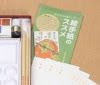
I just received the July issue of Gekkan Etegami, the official monthly magazine of the Japan Etegami Society. This month's issue features fish etegami submitted by readers from all over the country. The top photo shows living fish, including the one in the bottom right depicting baby catfish. The second photo shows shrimp and sea bream, both of which are prized for their reddish coloring, and which are served at weddings and other celebratory occasions. The third photo shows a variety of shell fish, and the next three photos show fish and other sea creatures in various stages of preparation leading to being consumed for dinner. The last photo shows what is left of the fish at the end of dinnertime. Yes, we are taught to pick our fish bones clean. And even bones are a worthy subject for etegami.
I wish I had the time and space to translate some of the more amusing accompanying words. I'll give you just one example: These dried whole baby sardines are the basis for a nutritious soup stock used in many dishes, but most commonly as the stock for miso soup. These little fish are often thrown out once their flavor has transferred to the soup stock, but if eaten with the soup, or dried and later crushed and sprinkled over rice, their bones provide a great source of calcium. The writing on the card translates to: "Hey you, yes we mean you. How's your bone density these days?"Friday, June 22, 2012
illustration friday (space)
![]() |
| hashi-oki (chopstick rests) |
There was a time in my late teens and early twenties when I seriously considered becoming a professional potter. My life unfurled in another direction entirely, but my love for clay and things formed from clay has always remained. For a while I satisfied that love by collecting earthenware dishes-- forms that delighted my eyes and hands, made with particular clays or techniques that represented different regions in Japan and other countries in Asia. But for a young family that was constantly on the move, pottery was too heavy, too fragile, took up space we didn't have, and was, quite frankly, too expensive a hobby. So I turned my eyes to ceramic hashi-oki, the "chopstick rests" that are often exquisite works of art in miniature, but are cheap, sturdy, and take up very little space.
![]() |
| handmade ceramic buttons |
Fast forward a few decades, and we come to the last year or two, during which I've had the pleasure of getting to know Vika, an artist who makes buttons, pendants, and brooches from clay. She is curious about Etegami, partly because she sees it as "art in miniature," similar to what she is making. She asks me about the aesthetics and processes of my work. From time to time she sends me beautiful buttons that she says were inspired by my etegami. Last year she interviewed me for a post on a blog called Beads of Clay. I owe her for opening my eyes to a world I had never considered before. The creativity and skill packed into each button astound me. Like hashi-oki chopstick rests, they are affordable, utilitarian, and take up very little space. Even someone like me, who never, ever sews and has almost no use for buttons as buttons, can spend many delightful hours touching and admiring each of these tiny morsels of art.
Sunday, June 17, 2012
the fathers in our lives (2)
Friday, June 15, 2012
illustration friday (secret)
![]() |
| pansy tears |
After my last IF post --on the topic of "Shiny" -- Sadami asked me to post more of my translations of Japanese poetry, and this one, another by the poet and songwriter Misuzu Kaneko, seemed to fit this week's IF theme:
Dewdrops
I will keep it to myself
that the flowers were shedding tears
in a corner of the garden
this morning.
If the news were to spread,
and the bees were to hear of it,
they would feel so guilty,
they might return the honey.
poem by Misuzu Kaneko
my translation
Subscribe to:
Posts (Atom)