Thursday, September 6, 2012

etegami calendars

"A Year of Etegami Flowers"

"All Creatures Great and Small"

"Illustrated Recipes"

"Words to Light the Way"
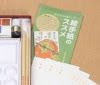
I've added new design choices to the Etegami Calendars I offer on my RedBubble gallery, so you can get an early start on a holiday gift for yourself or someone else. Another good reason to get an early start is that all four designs are being offered at 0% mark-up until September 15, which means you get them for the price of printing and not a cent more (apart from shipping charges). Think about it. Click here to see close-ups of each page.  

P.S. These photos show the back cover of each calendar. Three out of the four have an entirely different etegami featured on the front cover, so that gives you a total of 13 etegami in each calendar. The recipe calendar is the exception. It has only 12 different photos.

Wednesday, September 5, 2012

a new etegami newsletter

There has been a rising demand for an affordable English language substitute for the JES (Japan Etegami Society) monthly magazine "Gekkan Etegami," which is both outrageously expensive and (obviously) all written in Japanese. So I've decided to put together a monthly English-language newsletter devoted to the subject of etegami. I hope to summarize some of the more relevant articles in the JES magazine, as well as explain the history, trends, and techniques of traditional Etegami. I also want to introduce the works of popular Japanese etegami artists and current etegami contest information. It will be in the form of a PDF file, starting out at two pages per issue. I hope to send it out by email attachment at the beginning of each month, and it will be FREE of charge.
I hope to get the first issue ready to ship by October 1.  If you want to sign up for a copy, send your email address to dosankodebbie (at) yahoo (dot) co (dot) jp   

Tuesday, September 4, 2012

glorious summer vegetables

cucumbers

tomatoes

more tomatoes

eggplants

goya (bitter melon)

kabocha (Japanese pumpkin, top) and misc. veggies

corn on the cob

legumes (top) bell peppers (bottom)
In honor of summer's end, I selected some charming examples of traditional etegami from the pages of the September issue of Gekkan Etegami (the Japan Etegami Society's official magazine). These were painted and submitted by Society members throughout this summer.  I, as you know, spent most of the summer experimenting with new inks and painting styles. But when I saw these pictures, I fell in love all over again with good old traditional etegami.

Saturday, September 1, 2012

september give-away (etegami collages)

Snail with haiku by Issa
"Dust of Snow" by Robert Frost

Common theme in Japanese horror tales
From my Proverbial Cow series
Can you believer it's already time for the September give-away? I picked out four of my etegami-collages, one each for four randomly selected winners. Each one is from a different series, and each is an original etegami-collage constructed with painted etegami images and washi paper backgrounds, glued onto re-purposed stiff paper backings.  If you want to be considered for the give-away, please indicate this clearly in a comment below.  I will chose four names on September 8. As usual, I can't promise which work will go to which winner, but it would be helpful if you indicated your preference(s) anyway.   

Note: This give-away is limited to followers of this blog. If you aren't already following, there are three easy ways you can do this, and they can be found in the right-hand sidebar of this page. If you take this opportunity to newly follow/subscribe, please tell me which method you used.

Friday, August 31, 2012

illustration friday (identical)

Some of you may have seen this etegami before. I considered it a "failure" when I first painted it, but it grew on me with the passing of time, and now it's one of my favorites. The accompanying words are a haiku by the wandering poet Matsuo Basho (1644-1694). Don't imitate me. It's as boring as two halves of a melon.

Saturday, August 25, 2012

illustration friday (tall)

This etegami was inspired by The Tuft of Flowers, an early poem by Robert Frost. Like so many of my favorite Frost poems, it speaks of loneliness. But the second half of the poem refutes that loneliness, as the speaker (whose task is to toss the mowed grass) finds comfort in evidence of shared sensibilities and values with someone (the mower) who has left the scene. It is a long poem, so I'll just paste the second half here:


I looked for him behind an isle of trees;
I listened for his whetstone on the breeze.

But he had gone his way, the grass all mown,
And I must be, as he had been,—alone,

As all must be,' I said within my heart,
Whether they work together or apart.'

But as I said it, swift there passed me by
On noiseless wing a 'wildered butterfly,

Seeking with memories grown dim o'er night
Some resting flower of yesterday's delight.

And once I marked his flight go round and round,
As where some flower lay withering on the ground.

And then he flew as far as eye could see,
And then on tremulous wing came back to me.

I thought of questions that have no reply,
And would have turned to toss the grass to dry;

But he turned first, and led my eye to look
At a tall tuft of flowers beside a brook,

A leaping tongue of bloom the scythe had spared
Beside a reedy brook the scythe had bared.

I left my place to know them by their name,
Finding them butterfly weed when I came.

The mower in the dew had loved them thus,
By leaving them to flourish, not for us,

Nor yet to draw one thought of ours to him.
But from sheer morning gladness at the brim.

The butterfly and I had lit upon,
Nevertheless, a message from the dawn,

That made me hear the wakening birds around,
And hear his long scythe whispering to the ground,

And feel a spirit kindred to my own;
So that henceforth I worked no more alone;

But glad with him, I worked as with his aid,
And weary, sought at noon with him the shade;

And dreaming, as it were, held brotherly speech
With one whose thought I had not hoped to reach.

Men work together,' I told him from the heart,
   Whether they work together or apart.'

by Robert Frost

Monday, August 20, 2012

the shakespeare series (1)

from the poem "Blow, Blow, Thou Winter Wind"

from "Hamlet"

from "Romeo and Juliet"

from "A Midsummer Night's Dream"

from "King Lear"