Showing posts with label washi. Show all posts
Friday, December 26, 2014
short-cuts, but only when desperate
I can still remember the year I had to admit that my winter holiday mailing list had grown too long to send original hand-made cards to each person on it. I was swallowed by guilt at the time, but the list grows longer every year.
Getting my favorite seasonal etegami made into glossy postcards by a professional printer is one solution that I've tried, but many of my friends and family have expressed a strong preference for the tactile qualities of original washi etegami. And hating to disappoint, I've cast about for a better solution to the problem. For a while I printed my chosen image on the thick washi cards that I generally use when I hand-paint the originals. This produced printed cards that were hard to tell apart from the original etegami, but I gave it up after it wrecked my printer head twice in two years.
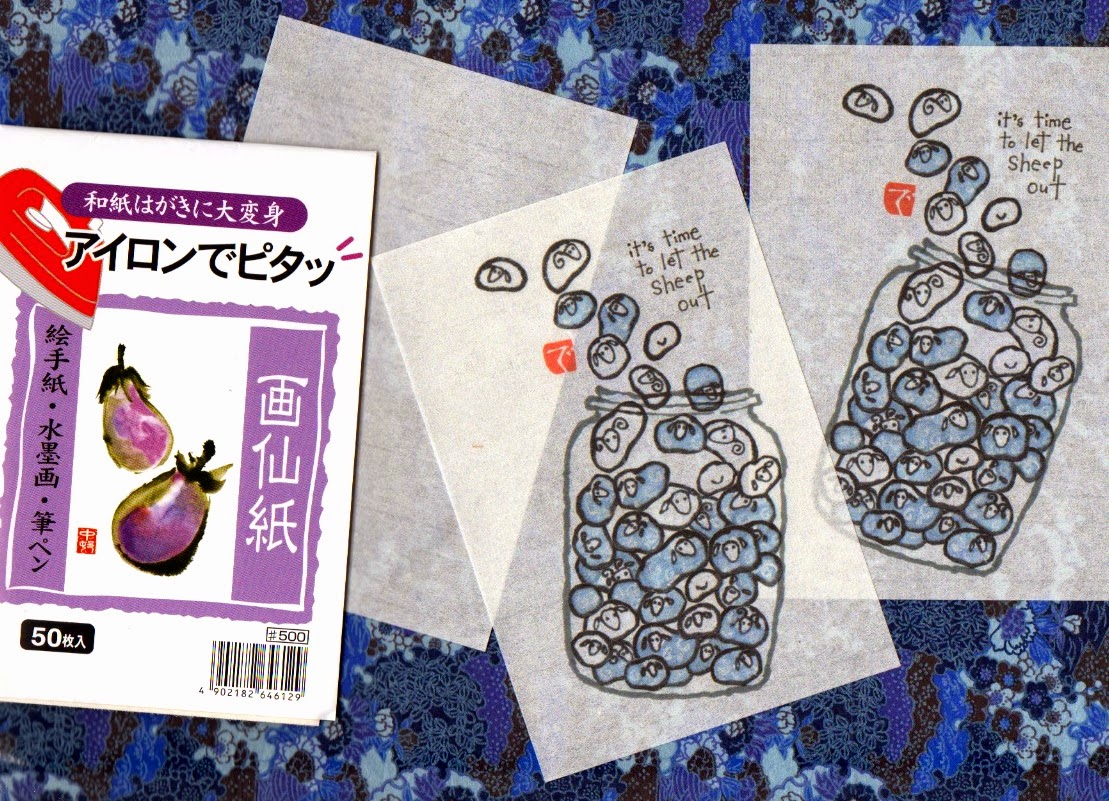
Recently I tried printing my holiday etegami image on iron-on washi sheets. I sell pads of these on my Etsy shop and I always keep a stock for my personal use. They are intended for converting ordinary blank postcards into washi cards for etegami, but I never meant for them to be used with a printer. Still, the results were pretty good. They were thin enough to go through the printer without excessively burdening the printer head, and after I ironed them onto ordinary blank postcards they retained the soft, slightly fuzzy feel of washi. The self-adhesive washi sheets work well for this too, but they're a bit more expensive. I pass the sheets through my printer one sheet at a time to prevent their getting stuck inside.
Wednesday, September 29, 2010
the french connection

A few days ago I received some mailart from @yun of France, who interacts actively with us on this blog. Enclosed with the card were two blank sheets of 45-gram-weight washi paper that appeared to be the right dimensions for hanshi, which is what we call the thin-ish washi sheets used for calligraphy practice.
Yun asked me to test the paper to see if it was a suitable substitute for the kind of washi cards I have recommended for etegami use. It seems she is able to find sumi ink, gansai paints, and traditional Japanese writing brushes in France, but not washi cards. So she had the idea of gluing washi paper to stiff cards cut out of cereal boxes. I tried out her idea.
I used the traditional Japanese writing and coloring brushes to paint the first two etegami (photo at the top), without first gluing them to a stiff back. I was happy with the way the sumi spread on the paper. The gansai paint also went on adequately, with a good amount of nijimi (bleed), but it tended to seep through the thin paper and wet the surface beneath. If I hadn't been careful, the pool of paint that collected beneath the paper would have stained the uncolored parts of the etegami as well. Fortunately, this didn't happen. After the etegami were dry, I glued them to cards cut from the back of a taco shell box. The washi paper tended to wrinkle as I glued it to the stiffer surface, but I managed to spread it flat enough that the wrinkles aren't too obvious.
Next, I tested it with the bamboo quill pen, but I thought it would work better if I glued the paper to a stiff back first. This worked great! (photo below) I was more careful with the colors this time, so there was no serious seepage. My conclusion is that this method works very well as a substitute for washi postcards. NOTE: Paint on the rough side of the washi sheet, not the smooth side.
Thanks, Yun! Yun also sent me a vibrant octopus etegami she had made, using the same washi paper glued to a stiff backing. I've posted it on the mailart gallery blog, so be sure to take a look.
Thursday, February 4, 2010
let's talk paper


Traditional etegami is drawn on washi postcards. Many different brands and types of these cards are available throughout Japan. I have a favorite brand that I've never found in stores, but which I order through a friend who has connections. Many of you have asked how to get hold of washi cards. Not having the faintest idea what is available overseas, I sent samples of various brands to friends in Europe and the United States, asking them to check with art supply stores to determine whether similar paper can be purchased there, and what it is called. So far, nothing like what I use has been found. Furthermore, according to Linda from St.Louis, in America the word washi is commonly used for colored origami paper that is quite unlike what we use for etegami, so asking for the paper by that name isn't much use.
Then I realized that not having the traditional tools and paper should not be an obstacle to pursuing etegami. The main thing is to try many different types of paper and learn how they responds to various inks. When you find something that appeals to you, keep experimenting with it till you are completely familiar with its characteristics and you can produce the kinds of images you want. Linda thinks watercolor paper is not a bad alternative, and she felt that 2-ply 100% rag had something like the absorptive quality of the card stock I use. I gave the paper that Linda sent me a try and found it did not respond the way my usual cards do, but it was similar to some other types of etegami cards I've seen.
I've attached photos which show the contrast between the brand of washi cards I usually use, and the high-quality 2-ply 100% rag card stock that Linda sent me. The image of the single eggplant is one I drew many years ago on my favorite washi paper. The image of the two eggplants is one I drew recently on the paper Linda sent me. When I apply paint to my usual paper, the color spreads horizontally, and I just lay (not stroke) the brush on the paper for as long as I want the ink to spread. This is a skill that took me a long time to master. With the new paper, the color will go only where I stroke the paint brush, and not beyond. This makes it a bit harder to make two different colors blend naturally together where they meet. And though I used the exact same gansai paint for both cards, I had to lay layer upon layer to get an equivalent intensity of color on the American paper.
I'm not at all an expert on paper and ink, and have no idea what makes them different from each other. I just jump in and experiment until I find what I like. There is a great variety of cards sold in Japan that are labeled for etegami use, but which have very different qualities from one another. So no matter where you live, it may take a while to find the one that feel "right" to you. Good hunting!
Tuesday, October 27, 2009
etegami collages

I've been going a little bit crazy over collages lately, thanks to being stimulated by the works of Western mail artists, who tend to be very collagic (? well, you know what I mean). My versions are always a combination of pictures and words, which technically qualifies them as Etegami. But I wasn't certain enough of this interpretation to introduce the collages on this blog. Then, the other day, I stumbled onto a blog about etegami made with fabric fragments. It was one more in a series of eye-opening encounters for me. You'll have to see these for yourself. The blog, called Ponpoko's Etegami, is in Japanese, but I think you will be able to see the images. Click here. The pictures are formed with bits of cloth and yarn. Sometimes, the artist writes the accompanying words by ink brush, and other times she forms them from yarn or fabric. If these delightful postcards can be called etegami, then my collages certainly can. If any readers of this blog are more comfortable working with fabric than with ink brushes and paints, you won't find me resisting that approach anymore. Just don't forget the element of words. The image I posted here is a collage of photos pasted onto a background made from the kind of hand-dyed wispy washi used in the art of chigiri-e, which I've mentioned in previous posts.
Sunday, October 4, 2009
beyond washi
The first time it hit me that etegami (at least a non-traditional version of it) could be done on material other than washi, was when one of my etegami colleagues showed me a card cut out of corrugated cardboard. The card had been cut out so that the logo of a cantaloupe was on one side, leaving the rest of the card free for a thank-you note. Other clever cut-outs and drawings decorated the blank spaces on both sides of the card. It turned out that my colleague sends a case of fruit to this woman every year, and every year, she returns a thank-you card crafted from the cardboard carton that contained the fruit.
Once or twice, I have run out of washi postcards and had to make do with cutting cards from old file folders. I blogged about it here. But it's been my recent exposure to international mail artists who cut their cards from old cereal and cookie boxes that really got me thinking about the possibilities. As appealing as the idea of recycling old cookie boxes is, it simply isn't possible to reproduce on such material the lines an ink brush makes on washi.
That's where this nifty product comes in useful: iron-on washi. These thin sheets of washi-like paper come 50 to a pack. They respond to sumi ink and gansai paints very much like ordinary washi postcards do. And they're much cheaper, so it doesn't hurt so much throw a sheet away if you mess it up. They're perfect for making etegami out of otherwise unsuitable card material. I dug out some great oriental-patterned boxes that had once contained traditional Japanese confections, thinking the postcards I could make from them would be sure to please someone with an eye for beautiful patterns. I painted my pictures on the iron-on washi sheets and ironed the drawings onto the un-patterned sides of my make-shift cards, leaving the patterned sides for address labels and postage stamps. They turned out great. So great, I almost don't want to send them....
Subscribe to:
Posts (Atom)