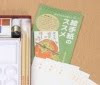
Traditional etegami is drawn on
washi postcards. Many different brands and types of these cards are available throughout Japan. I have a favorite brand that I've never found in stores, but which I order through a friend who has connections. Many of you have asked how to get hold of
washi cards. Not having the faintest idea what is available overseas, I sent samples of various brands to friends in Europe and the United States, asking them to check with art supply stores to determine whether similar paper can be purchased there, and what it is called. So far, nothing like what I use has been found. Furthermore, according to Linda from St.Louis, in America the word
washi is commonly used for colored origami paper that is quite unlike what we use for etegami, so asking for the paper by that name isn't much use.
Then I realized that not having the traditional tools and paper should not be an obstacle to pursuing etegami. The main thing is to try many different types of paper and learn how they responds to various inks. When you find something that appeals to you, keep experimenting with it till you are completely familiar with its characteristics and you can produce the kinds of images you want. Linda thinks watercolor paper is not a bad alternative, and she felt that 2-ply 100% rag had something like the absorptive quality of the card stock I use. I gave the paper that Linda sent me a try and found it did
not respond the way my usual cards do, but it
was similar to some other types of etegami cards I've seen.
I've attached photos which show the contrast between the brand of
washi cards I usually use, and the high-quality 2-ply 100% rag card stock that Linda sent me. The image of the single eggplant is one I drew many years ago on my favorite
washi paper. The image of the two eggplants is one I drew recently on the paper Linda sent me. When I apply paint to my usual paper, the color spreads horizontally, and I just lay (not stroke) the brush on the paper for as long as I want the ink to spread. This is a skill that took me a long time to master. With the new paper, the color will go only where I stroke the paint brush, and not beyond. This makes it a bit harder to make two different colors blend naturally together where they meet. And though I used the exact same
gansai paint for both cards, I had to lay layer upon layer to get an equivalent intensity of color on the American paper.
I'm not at all an expert on paper and ink, and have no idea what makes them different from each other. I just jump in and experiment until I find what I like. There is a great variety of cards sold in Japan that are labeled for etegami use, but which have very different qualities from one another. So no matter where you live, it may take a while to find the one that feel "right" to you. Good hunting!


 Posts
Posts