Showing posts with label nengajou. Show all posts

Tuesday, January 3, 2017

a chicken-y new year (2)


Every year the Japan Postal Service offers postcards pre-printed with specially designed postage stamps and cancellation marks depicting the zodiac animal of the new year. These postcards are meant to be used for the traditional exchange of New Year greetings (nengajou). According to the Chinese zodiac, 2017 is the year of the rooster-- although in Japan, we prefer to broaden the term to include all chickens.

You may remember a post from two years ago about this very tradition. In fact, it wasn't until that year that I began to pay attention to the design of these stamps And when I started paying attention, I began noticing some delightful things that increased my already high admiration for the Japan Postal Service.

This year, my favorite of the pre-printed stamps depicts a rooster taking a selfie with his smart phone, a happy young chick hopping at his side. The cancellation mark depicts the same rooster in a pose of Zen meditation-- seated in the traditional manner, eyes closed and head slightly bowed-- while the chick plays the role of a temple priest brandishing the wooden stick that is used to remedy lapses in concentration. I was impressed with this clever combination of the new and the old in Japanese life, and I hope it amuses you too.


a chicken-y new year (1)


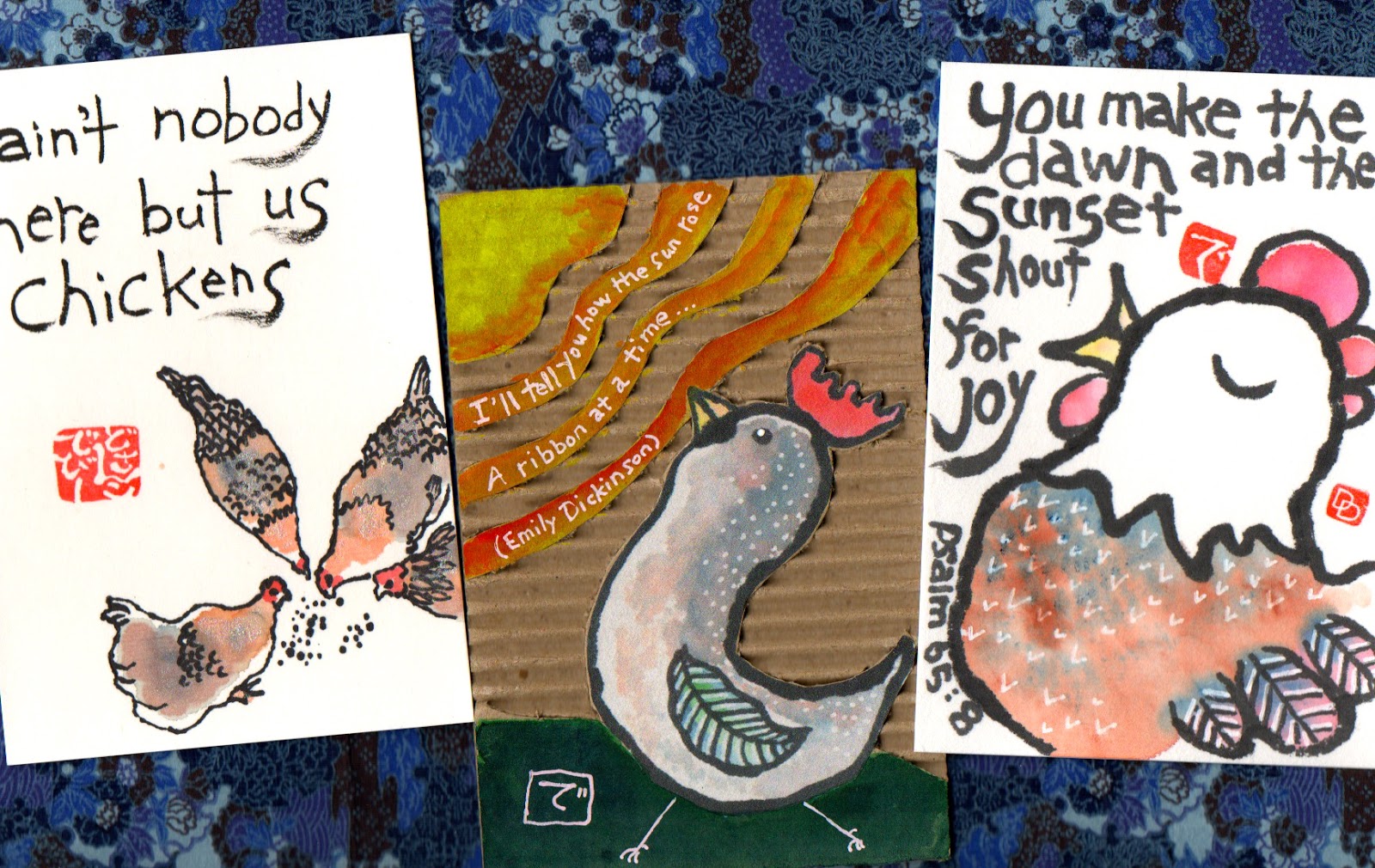
Here are a few of the chicken-y etegami I made to send out in time for New Year's Day delivery. I've written often on this blog of the Japanese custom of sending New Year postcards (nengajou), so rather than repeating myself here, please check out this post for an overview of the history and tradition of nengajou.

According to the Chinese Zodiac, 2017 is the year of the rooster, but in Japan, we don't limit ourselves to roosters. Our New Year's cards and decorations are clucking and peeping with hens and newborn chicks too.  Even chicken eggs, or birds other than chickens.

The photo (below) shows just a few of the big stack of nengajou I found in my mailbox on New Year's morning. Some of the cards depict auspicious subjects other than the zodiac animal of the year: for example, plum blossoms, red-crowned cranes, Otafuku (a plump-cheeked, smiling woman said to bring luck and happiness), and --of course-- Mt. Fuji.


Most of the nengajou are printed on postcards with pre-printed lottery numbers on the addressed side. The post office announces the winning numbers in February. I often have at least one winning number in my pile that qualifies me for the smallest prize of collectable postage stamps.

When I was a child they used to give away television sets and bicycles for the top prizes, but I never knew anyone who was that lucky. The hand-painted nengajou I receive from my etegami friends, which I value the most among all the cards I receive, are not painted on the pre-printed lottery cards (which are not absorbent enough for etegami). But there is a second way to participate in the lottery, and that is by affixing to your own hand-painted card a special New Year postage stamp printed with a lottery number.

Monday, January 4, 2016

a barrel of monkeys


Happy New Year to all my blog followers and mailart friends! In Japan, it's already the evening of January 5th. I don't know where the first 4 days of this year went. I hate to think how fast next New Years will sneak up on me.

Every year I get fewer and fewer art nengajou (New Year postcards) and, rather than all arriving on January 1st, as is the custom, they trickle in until mid-January. But I am just as guilty of sending fewer and later, so I am delighted and thankful for all cards that I receive.

Some of the etegami nengajou that arrived this week are shown in the photo at the top. All but one depict monkeys (yes, the gorilla counts) for celebrating 2016, the year of the monkey. The exception is the one at the top, far left, representing a shishi-mai, or Japanese version of a lion dance.


I sent out as many handmade New Year etegami as I could manage, though many were the non-orthodox sort. ... collages of etegami images glued onto corrugated cardboard covered in vintage-kimono fabric scraps, for example. Like those posted in the second photo. The one with the image of a red-crowned crane (very auspicious!) doesn't even have words on the image side, so it doesn't  count as etegami I suppose. Still, it was fun, and I hope the receiver enjoys it.

Wednesday, January 1, 2014

new year's day in japan


Japan has a long tradition of exchanging New Year's greetings in writing, going as far back as the Nara period (AD 700s). But it wasn't until 1873, when the Japan Postal Service began to print standardized postcards requiring less postage than an ordinary letter, that the idea of postcard greetings, called nengajou, began to catch on. In 1899, the current system of nenga yuubin (New Year mail) was conceived, in which all mail which is marked nenga (New Year's greeting) and posted within a specific time frame in December, gets delivered en mass on New Year's Day.

There are many cool things about nengajou postcards, not the least of which is how images and words are used.

Certain auspicious images are associated with the New Year holiday specifically, or with spring in general-- since New Year's Day is the symbolic beginning of spring. Images commonly used on nengajou include red-crowned cranes, Mt. Fuji, plum blossoms, and the zodiac animal that goes with that particular year. Toys like fighting spinning tops, colorful playing cards, kites, and brightly painted hanetsuki paddles may be depicted on these cards because they are among the toys that children traditionally played with during the New Year holidays. Click on the links to find out more about these toys.

Word-play abounds in nengajou. A card with the image of a spinning top might say: May 20xx be a well-balanced year for you. A card depicting a kite might say: May you reach new heights this year.

Not all New Year's cards are etegami, of course. These days most people whip up greeting cards on their computers and printers, using stock images and formulaic words. Hand-made nengajou are all the more valued because of this.

2014 is the year of the horse. The pictures posted here are just some of the many, many nengajou that were delivered to my door early this morning. A few came from people that weren't already on my list, so I will spend the next few days painting more nengajou to send in reply to those cards. They will get delivered several days late, of course, but it is not uncommon for people to have no time to make and send nengajou until the holidays have actually started. In fact, I expect to receive the bulk of my nengajou in small batches during the next several days, until the total is two or three times the number I received today. It's the thought that counts, of course, and nengajou are a really fun way to convey those thoughts.


Monday, December 30, 2013

dear mr. postman

Every year I try to paint a New Year etegami for my local post office to thank them for their fantastic service on which I so depend. The thing that looks like a T with a bar above it is the symbol for the Japan Postal Service.

The Japanese writing on this one basically means I will count on you this year as always, but the word for "count on/depend on" has the same sound as the word for "letter/correspondence," so I playfully used the latter character for the former meaning to make a pun. The horse, of course, represents 2014, the year of the horse. The various bags are mail delivery bags, and I pressed my Japanese name stamp on the bag at the top of the pile.

Saturday, November 9, 2013

inspiration for new years cards

Here's a cool link to some samples pages of the November issue of the Japan Etegami Society monthly magazine. It features ideas for New Years Etegami with horse-dolls and images sent to the magazine by readers. 2014 is the Year of the Horse. 

Tuesday, January 10, 2012

the japan postal service


A recent article on the thought-provoking blog Cheerio Road takes on what my cousin Karen calls the demise of the US Postal Service. Woven cleverly into the article is an introduction to the art of etegami, but you must (please) read it for yourself to see what it signifies. You may even want to try your luck with the etegami coasters giveaway. : )

Do you remember what I wrote in my January 1 post about Japanese New Year postcards? I wrote: The cards ... arrive on New Years morning in a bundle fastened with a rubber band. At the top of the bundle is a greeting from the Japan Postal Service with their best wishes for the new year. I though you might like to see this year's JPS greeting card (above), with the photo of the mailman on his red JPS motorbike, riding along a path through the rice paddies in a picturesque rural area. The writing translates as follows:

Happy New Year from the JPS group. We wish to convey our most sincere appreciation for your patronage. Ours is a country where people send their hearts to one another at the start of each new year. Once again we deliver to you-- distilled in the form of New Year postcards-- the love and thoughts of the people most dear to you. Connecting people to people, community to community. We at JPS promise to re-examine what we are fundamentally here to do, so that we can better provide you with reliable services that are worthy of your trust. January 1, 2012

The sentiments expressed here are part of why I don't think JPS is going to fade away any time soon, in spite of the internet revolution. A few years ago, I wrote a post about the JPS and its relationship to the art of etegami. Dismiss it as clever marketing if you like, but the JPS really does make itself indispensable to community life.

Monday, January 2, 2012

the dilemma

Seahorses. "Moving Forward"

Sprouting Water Chestnuts. "Hope Sprouts"

Flying Daruma Kite with Issa haiku.

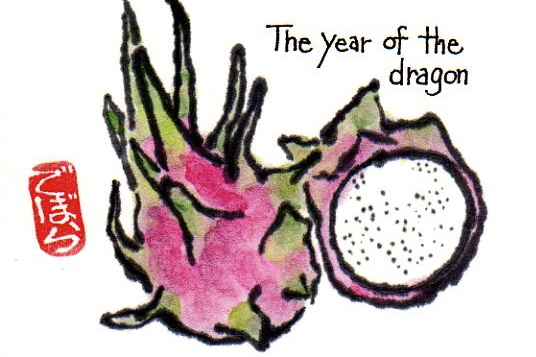
Dragon fruit

Every year I write about nengajou (Japanese New Year postcards) traditions on this blog, but I never thought to mention that tradition prohibits a certain group of people from participating in this annual exchange. These are the people who are in ritual mourning due to the loss of a family member during the year preceding the New Year's Day in question. Instead, about a month before New Year's Day, they send totally unadorned cards to their friends and business associates explaining why they will not be sending out nengajou, and which of their family has passed away.

Because of the tremendous devastation and loss of life resulting from the March 11 disasters, the whole nation was (and continues to be) in mourning. At the end of 2011, there was a lot of discussion, in private and in the media, about whether nengajou should be sent out at all, even if one hadn't actually lost a family member. It was generally agreed that it would be okay for nengajou to be exchanged among those who had not lost a family member. However, in deference to those who had suffered loss, people exchanging cards should avoid certain phrases that were overly joyful or congratulatory.

I listened to these discussions with only half my attention, because the boundary between acceptable and non-acceptable phrases seemed a bit too subtle for me to take seriously. And besides, the same arguments had gone on all year regarding whether it was proper to enjoy cherry blossom-viewing or summer festivals with fireworks or any number of fun things, while so many people in our country were suffering such enormous pain and sorrow. Opinions were always sharply divided, even among those who were the most severely affected.

Nevertheless, when the time came to chose the words to go on my etegami nengajou, I did ponder on this matter, and rather than using words like Happy, Joyful, or Celebrate, I chose words like Hope and Moving Forward. Not because I am overly concerned with propriety, but because if my choice of words can cause either pain or comfort, I would rather they cause comfort. 

The etegami I've posted above are some of the ones I painted as this year's nengajou. I blogged about the dragon etegami a few months ago. If you missed it and would like to see it, click here.

Sunday, January 1, 2012

nengajou highlights


The highlight of every New Years Day is the nengajou (Japanese new year greeting postcards) that arrive sometime during the morning. People sending traditional nengajou must slip the cards through the specially-labeled nengajou slot in the mailbox before a pre-determined deadline (usually around December 24) in order to be guaranteed delivery on January 1. The cards that make the deadline arrive on New Years morning in a bundle fastened with a rubber band. At the top of the bundle is a greeting from the Japan Postal Service with their best wishes for the new year. The cards that don't make the deadline get delivered with the regular mail, after the holiday is over, and after the postal service is back to normal operation.

I just love the excitement of waiting for nengajo delivery on New Years morning! The images posted here are my favorites (so far) among the artsy cards from this year's haul. Some are hand-painted originals, others are prints made from original artwork. I expect more will trickle in after the holiday is over. Eventually, I will store them in a special nengajou card album. I refer to these albums when it's time to make next year's nengajou address list. I also refer to the album in twelve years' time when the oriental zodiac comes full circle, to get inspiration for my own etegami nengajou designs.

This year's zodiac animal is the dragon, and most of the cards I received, even the majority that were not handmade, depicted a dragon of some sort. Sea horses count as dragons, as they are called "dragon children" in Japanese. But the zodiac animal is by no means the only felicitous image for a New Year card. Mt.Fuji, a brilliant sunrise, red-crowned cranes, flying kites, the otafuku mask (as in 2nd image from the bottom) and many more images are used for nengajou.

Dearest friends and followers, May you have a blessed and joyful 2012!

Monday, September 26, 2011

dragons


My mind is currently full of dragons; The reason being that I start thinking of designs for my etegami nengajou (Japanese New Year cards) around this time of year, and 2012 happens to be The Year of the Dragon.

Here are a couple that I just finished. The first was inspired by The Tale of Custard the Dragon, a sweet and funny poem by Ogden Nash, which is too long to post here. The second was inspired by The Dragon of Grindly Grun, a funny poem by Shel Silverstein, which (in a strange way) appeals to my passion for cooking. It's short enough to quote in full, so here it is:

The Dragon of Grindly Grun

I'm the Dragon of Grindly Grun,
I breathe fire as hot as the sun.
When a knight comes to fight
I just toast him on sight,
Like a hot crispy cinnamon bun.

When I see a fair damsel go by,
I just sigh a fiery sigh,
And she'd baked like a 'tater-
I think of her later
With a romantic tear in my eye.

I'm the Dragon of Grindly Grun,
But my lunches aren't very much fun,
For I like my damsels medium rare,
and they always come out well done.

by Shel Silverstein (1930-1999)

Friday, December 31, 2010

nengajou (received n.y. cards)

The message gives the traditional New Year greeting with the addition of a private message to me. The image depicts one of the seven lucky gods that is referred to a lot at this time of year.


Shows tiger (2010 zodiac) turning into a rabbit (2011 zodiac). Printed words translate roughly to "Having long ears doesn't make you a rabbit." In his private message, the artist says he's resolved to quit pretending to be other than what he is.

This lino-cut rabbit is accompanied by the words: "May this year be full of happy things." The artist is a certified etegami instructor and reminds me time and time again that the best etegami is simple and childlike.

Rabbit and carrot etegami with "Beginning of Spring" in gold ink. This is another common way to refer to the New Year. Even if the cold and snow continues for many months, New Years Day is when we rejoice in the expectation of Spring and in new beginnings.


This is the second year I've receive a nengajou from this artist, and once again she has delighted me with her creative ideas. The card is overlaid with soft, fluffy, wrinkled washi paper and stamped with an utterly adorable bunny seal. On the other side is her greeting: "Happy Fluffy New Year!"

I've come to expect gorgeous colors & fine technique from this etegami artist, and this nengajou does not disappoint. The words are one more version of the traditional New Year greeting done in strokes oozing with character.

This nengajou is from a new etegami friend whose work has been posted several times on my mailart gallery blog. It may be hard to see, but the gold ink added to the bunny and the waves conveys wishes of good fortune and happiness. The accompanying words say "With a Fresh/Renewed Heart and Mind."

It is already New Year's Day in Japan, despite what date might appear at the top of this post. The mailman delivered the first batch of New Year cards, presumably the ones that were posted before the Dec 24th deadline. Cards from those who mailed theirs after the deadline (that includes me :p) will trickle in during the next few days. I'll post more soon. : ) To learn more about the Japanese tradition of exchanging New Year postcards, check out this post from last year.

Tuesday, January 5, 2010

all kinds of tigers


While I was delighted by the number of nengajou (traditional Japanese New Year cards) I received this year, the percentage of hand-drawn cards was probably the smallest in decades, and has me puzzled. I had imagined that the ailing economy would result in an increase of hand-made cards, but apparently this does not follow. Of the three cards I've posted here, only the one in the center was done by traditional etegami method-- with sumi ink on soft washi cards. I don't know if you can tell that the sender used gold paint on this card. Gold and silver gansai paints are not included in standard gansai sets. They have to be ordered separately, and are used for special occasions such as New Year's.

The card on the right is a block print. Yes, the cards depict tigers. Not kitty cats. It seems that in these modern times, people hesitate to use ferocious images on their felicitous greeting cards. I've noticed this in other years, whether it be the year of the mouse or the year of the dragon. Images tend to be cute or humorous. The card on the left was made on a computer, but I included it because it is an original design by an elderly sculptor friend of mine. Notice the stripes hanging off the tiger's body. The accompanying words declare the sender's intent to lose weight in 2010.