Showing posts with label mail art. Show all posts

Monday, May 11, 2015

more candy box mail art


Last month I received a small box of leaf-shaped cakes from Yun, my etegami friend in France. The cakes themselves didn't last long enough to appear in the photo I posted on my received mailart blog, but if you click the link, you can see the empty box and Yun's corrugated cardboard etegami that shows what the cakes looked like.

Even empty, the little box charmed and intrigued me. I had opened it in such a way as to leave the cellophane wrapping mostly undisturbed. So not only did the box look unopened, the diamond-shaped hole appeared to have window glass in it.

I cut out a flat "tray" from corrugated cardboard that slid smoothly in and out of the box, and glued flowery chiyogami (washi craft paper) and my favorite etegami bee images onto the tray. The bees were glued to bits of thick corrugated cardboard to give them a pop-out look.  Finally I added words appropriate to the scene, and tucked the finished tray into the box. The part of the tray that you can see through the "window" has enough depth to make it seem like you're peeking into another world. I was planning to send the finished box to Yun, but I'm enjoying it so much that I think I'll keep it for a while. :)

Tuesday, May 5, 2015

life in the 19th century (mail art call)


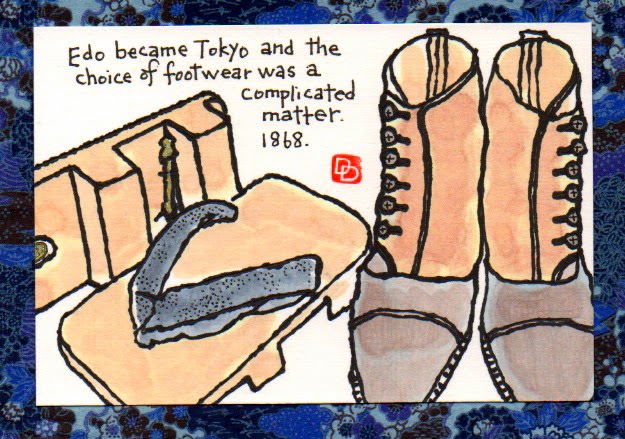
A momentous event happened in mid-19th century Japan. The Tokugawa (Edo) government, which had controlled Japan with an iron hand for 250 years, crashed and gave way to a new government brought about by the Meiji Restoration. The accompanying changes, including a new openness to western culture, must have seemed drastic and strange to the ordinary person at the time. Suddenly, choosing footwear was more complicated than it had ever been before....

I painted this as my submission to an Italy-based mail art call on the theme "Life in the 19th Century," and YOU are invited to participate too. I copied and pasted the following details from the event's Facebook page:

Artists from all over the world are invited to participate in this International Mail Art Project organised by the Faenza’s Watercolourists Association. Everyone is welcome to participate, all ages and skill levels. An exhibition of the received works will have place in Faenza, Italy, during the first days of November 2015 for the yearly St. Rocco fair of the city . All the works will be exhibited online in a special album posted in the event too and later there will be also pictures taken at the exhibition.
Theme: “Life in the XIX century” (years 1800/1899)
Size: Postcard (10 x 15 cm)
Technique: Free (watercolour, painting, drawing, collage and so on)
Rules: No jury, no fees, no return of the works, only original works, no copies. It is up to the artist to send in envelope or not, only 1 piece for each artist.
Deadline: Works must arrive by the 1st of October 2015.
Please clearly indicate name, address and email address on the back of the card.
Send your card to:

Associazione Acquerellisti Faentini
c/o Silvano Drei
Via Portisano 46
48018 Faenza (RA)
Italy


Saturday, April 25, 2015

i cannot walk but i can fly


When I woke up this morning, there was an email from RedBubble reporting the sale of some of my etegami prints, including one that I  hadn't thought of in ages. So I clicked the link to refresh my memory, and as soon as I read the description I'd written for it, I vividly recalled the day I had painted it. The words in the description are even more true of me today than when I first wrote them.

"Various physical disabilities keep me housebound for most of the year, but thanks to postage stamps, a part of me is able to fly all over the world and visit with people who visit me back in the same way. This is how I feel about Etegami, Japan’s version of mail art. Even without a common language, my hand-painted cards speak to the recipient on my behalf. Postage stamps are my wings."

Tuesday, March 31, 2015

brain food

My last etegami project left me so drained, I've been having trouble concentrating on the next one.  So I decided to have fish for lunch. Welllll, didn't your mother teach you that fish is brain food?

I googled it to make sure, and my wise mother's teaching was confirmed. Actually, I eat fish almost every day anyway-- but of course, I live in Japan, and we know a thing or two about good fish.

Anyway, after my brain food lunch I got inspired to make some brain food mail art. Here's another set for my on-going candy box mail art series. Let me know if you'd like one.

Tuesday, March 10, 2015

more candy box mailart


When my husband thinks that I need cheering up, he gets me a box of these chocolates. They're cheap,  readily available at super markets and convenience stores, and they are delicious! One of the fun things about this brand is that they change their box designs frequently to celebrate the changing season or new flavors-- some of them limited-time-only flavors.

Another reason I like this brand is because of the way the box is constructed. You open it by pulling back the right edge of the box, and it can be re-closed. The bite-sized pieces of chocolate sit on a small, stiff-paper tray that can be pulled out and pushed back in. Even empty, the box is stiff enough to survive being sent through the postal system in an envelope. It is perfect material for mail art.

I filled this one with bees printed from an original etegami. I inscribed one of my favorite bee-related quotes on the inside of the flap (not visible in the photos), and glued a playful warning onto the front of the box. I gave the tray of bees a three-dimensional effect by mixing flat images and images glued onto corrugated cardboard.

The box, the printer paper, and the corrugated cardboard are all previously used materials that are reused for this purpose. I make them in English and in Japanese with lots of different themes, and may even get brave enough to make them in other languages someday for my international mail art friends.


Friday, December 17, 2010

illustration friday (mail)


This is not really an etegami, but it *is* an image accompanied by words, and it certainly fits the new Illustration Friday theme. I did a series of Japanese Mail Collection Box collages to send to Postcrossers a couple years ago, and this is one of them.

It shows the kind of mail box that was used when I was growing up, and the shape of it is very dear to my heart. The modern ones are just a rectangular box on a pedestal (blah).

One of the memories from my childhood that I treasure, is of my father teaching me how to collect stamps. Now that I have trouble walking, and rarely leave the house, exchanging mailart is one way for me to travel the world. Stamps are little windows into new landscapes, rare creatures, and unfamiliar history. The canceled stamps I used for this piece are ones I collected over forty years ago. They depict national parks and nature reserves from all over Japan.

Monday, August 10, 2009

evolving into a global mail artist


My fairly recent discovery of the global community of mail artists has had an enormous impact on the way I think of etegami. Wikipedia has this definition of mail art: Mail art is art which uses the postal system as a medium. The term mail art can refer to an individual message, the medium through which it is sent, or an artistic genre. Mail art is also known as postal art and is sometimes referred to as Correspondence/Mail Art (CMA).

This may or may not be a sufficient definition of Mail Art. One site I came across further specified that the artwork must be visible to the people handling the mail on its way to being delivered. In other words, it's not Mail Art unless the mailman can see it. Art on postcards, such as etegami, qualifies (as long as it's not enclosed in an envelope), but art on the envelope itself also qualifies.

Though I think of myself as primarily an etegami artist, the astounding variety of styles and approaches towards mail art around the world has been a wonderful stimulus to my work. The images I posted above are of an etegami I am submitting to a mail art exhibit on the theme of The Sea. The drawing on the top is a porcupinefish (harisenbon) in repose. The drawing below it is the same fish in defense mode. This is the first time I've drawn on both sides of the card. Drawing on the side where the address goes is a little tricky, but it was a cool experiment, and I think I'll do it a lot more from now on.