Monday, April 7, 2014
giving old etegami new life
A few years ago, I painted this etegami-- depicting a butterfly fresh out of its chrysalis, still moist and a little crumpled-- on an A5-sized (about 8 x 6 inches) card to illustrate the expression "okagesama de." You can find the original post here to learn about the important role this expression has in Japanese life.
Today I decided to give the card new life as an Easter card, accompanied by English words. With careful cutting, I was able to reduce the card to 4 x 6 inches and remove the original Japanese words completely from the scene. There was enough empty space left to add the English words I had picked out. And here it is, a new etegami from the old, serving a completely different purpose from the original.
I actually do this a lot with old etegami that I've painted for some kind of art challenge rather than for immediate mailing. Especially when, like now, my eyes are too strained to paint new images. I think I like the proportions of this new version better too.
Sunday, April 6, 2014
insomnia
This is Alix the bear. Why is he not cheery? you ask. Well... it's the season for him go into hibernation, but he has insomnia. Poor thing.
I've been asked to illustrate two story-poems. I've just begun. Where will it take me? We shall see. We shall see...
Wednesday, April 2, 2014
because i'm happy
When I first heard Pharrell Williams' song Happy, there was one line that jumped out at me and begged to be used in an etegami. I felt I had just the image for it in this etegami collage I'd started a few years ago but never quite completed. The ladybugs are my dosankodebbie avatar, and if I can remember that far back, I think I was trying to express some kind of freedom of spirit. What do you think? Does the image work with the quote?
This etegami is for sale on my new Zibbet shop.
For those unfamiliar with this song, here is a link:
Saturday, March 29, 2014
etegami travel diaries
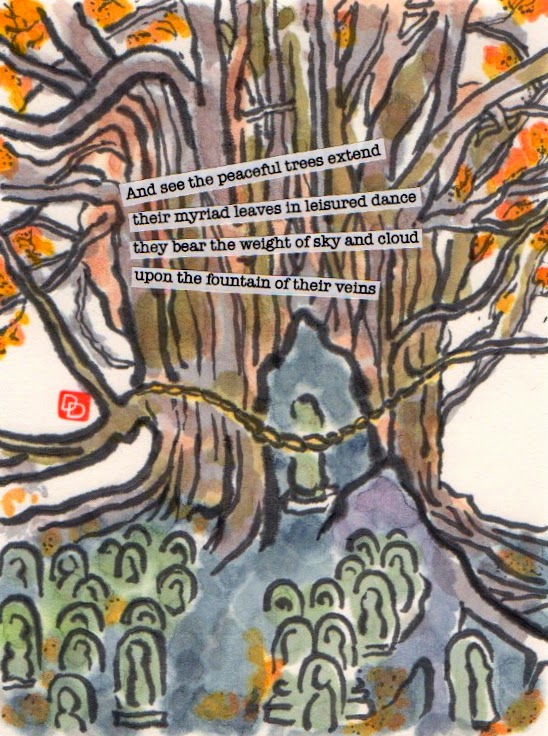
In my Beginner's Guide to Etegami book, I have a section on etegami travel diaries which includes this image of a 700-year old Katsura tree surrounded by Buddhist statues. The tree is encircled by an old rope, which marks it as a sacred place. But it was the glow of the fall leaves, both on the branches and on the ground, that persuaded me to linger until I could burn the scene into my memory.
When I paint a scene like this, which fills so much of the card that there's hardly any room for words, I often type the words onto a sheet of printer paper, cut them out, and glue them to the card. The typed words in their strips of white provide a contrast to the organic quality of the colorful image, making them easier to read. I separate each line from the others by fanning them out like this to avoid blocking too much of the image and to allow better blending (without getting lost) into the background.
These lines come from the poem Envoi, by the British poet Kathleen Raine.
When I paint a scene like this, which fills so much of the card that there's hardly any room for words, I often type the words onto a sheet of printer paper, cut them out, and glue them to the card. The typed words in their strips of white provide a contrast to the organic quality of the colorful image, making them easier to read. I separate each line from the others by fanning them out like this to avoid blocking too much of the image and to allow better blending (without getting lost) into the background.
These lines come from the poem Envoi, by the British poet Kathleen Raine.
Friday, March 28, 2014
whiskers and tails
I've started a new series of cat and dog etegami with a different focus than my previous work. Please send me a photo of your dog or cat that clearly shows their tail or whiskers. If it inspires an etegami, I will send you a copy. Email your photo to dosankodebbie (at) yahoo (dot) co (dot) jpWednesday, March 19, 2014
cultural heritage series
![]() |
UNESCO recently registered “Japanese Cuisine” as an intangible
cultural heritage of the world. To commemorate this event, I did a
series of etegami depicting dishes that I felt expressed the connection
between Japan’s food and cultural identity.
The first illustration depicts a box having lots of compartments filled with a wide variety of tidbits generally called Osechi, which is the label given to food prepared especially for New Year’s Day. Each item has some kind of auspicious meaning, often based on wordplay, although sometimes the significance is in the shape or color of the item.
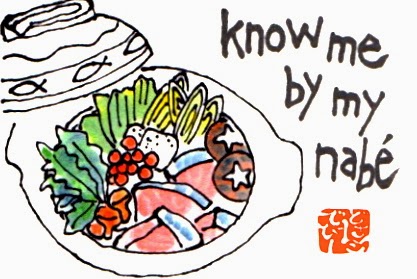
The second illustration depicts Ishikari Nabe, a hot-pot dish that represents Hokkaido, the part of Japan I call home. This Ishikari Nabe features sea food and agricultural produce for which Hokkaido is known (particularly salmon and salmon eggs). Many regions of Japan are represented by their own particular nabe recipe.
I used a black felt pen instead of the traditional fude writing brush and sumi ink for these, so they don't look much like traditional etegami.
Tuesday, March 18, 2014
etegami published in kyoto journal

Subscribe to:
Posts (Atom)