Showing posts with label Japanese proverbs. Show all posts

Tuesday, June 10, 2014

like playing with paper dolls


I've blogged many times about recycling etegami, but my motivation for doing so is not necessarily the same each time. Sometimes I like the image, but am disappointed with the writing, so I cut out the image, glue it to a new card, and redo the words. Sometimes I use faded or damaged etegami in making a paper pulp to produce new washi for new cards.

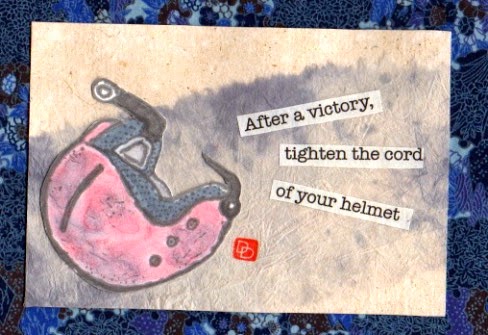
And sometimes, like today, after scanning the original etegami for my records, I cut out the image, glue it to a fresh background, and put the same, or similar, words in another language to reach a wider audience. Only the final version actually gets sent in the mail. The earlier versions only remain in digital form.

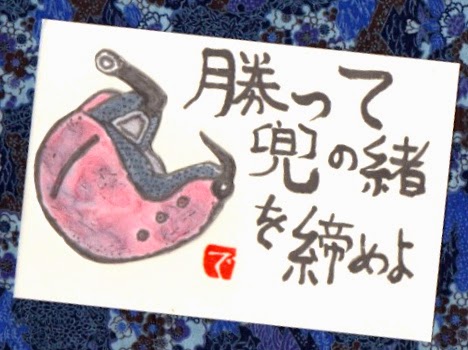
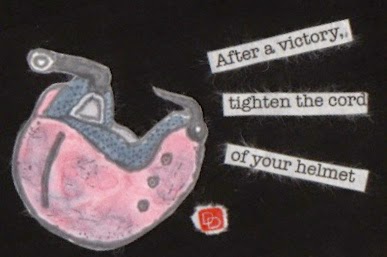
The words on each of these cards have the same meaning. It's the old Japanese saying: After a victory, tighten the cord of your helmet. In other words, don't let the euphoria of victory make you careless. I drew this bike helmet long ago to illustrate a short story a friend wrote about a motorcycle accident, and decided to turn the illustration into an etegami. Then I took it apart and made a new version of it in English. And then I did it again with a different background.

It kind of reminds me of the paper dolls I played with as a child. I remembered this morning that I used to draw and cut out my own paper dolls and design the clothes I would make them wear. Probably lots of children did the same. Maybe my etegami play a similar role for me in my old(er) age. Today I'll put you against a blue background with German words, I say to my image, How would you like that? Am I weird?

Sunday, March 9, 2014

a snake, a proverb, and a bit of accidental irony

I had an unfinished snake etegami left over from making new year cards for 2013, the year of the snake. So I wrote the words of a Japanese proverb and added it to my long-neglected Japanese Proverb series. 

Translated literally, the words say "let yourself be wrapped up by what is long," and it means that the safest course of action is to do whatever the person in power (your boss, for example) wants. 

It's a proverb I've never illustrated before, because it irritates me. I've decided to leave it uncolored for the time being. It will soon be on its way to a Postcrosser in the Ukraine. Oops, I just realized the irony of that. Hmm, maybe I'll send it to the Postcrosser in the Netherlands instead. 


Sunday, June 10, 2012

winners of the june give-away


Congratulations to the lucky winners of the June Give-Away!

Leah from Oddments & Curiosities blog is the winner of "bell crickets"
Sadami  from Sadami's Graffiti blog is the winner of "snake in the shrubbery"
Eric from My Philately blog is the winner of "bee sting"
Christine H from The Daily Postcard blog is the winner of "weaving a rope"

I will send you the hand-painted original artwork from my Japanese Proverbs series as soon as I have your postal addresses. If I haven't reached you by the time you read this, please go ahead and send your address to the contact email on my profile.

And to the other great people who left comments, there will be another give-away around September, so please try your luck again. If you aren't already "following" this blog, I encourage you to do so. You'll be less likely to miss future posts, and besides, it makes me feel loved.....
In the meantime, I appreciate your continued support. oxox

Sunday, June 3, 2012

june give-away: japanese proverbs

left: "weaving a rope after the thief is already caught" right: "poking at a snake in the shrubbery."


left: "it's for their songs that bell crickets are caged." right: "a bee sting on a crying face."
I had promised you another give-away when June came around, so here it is. I'm giving away four original, hand-painted etegami from my Japanese Proverbs series, the series I painted in 2010, and which became the basis for my 2011 Sketchbook Project titled "A Collection of Japanese Proverbs and Sayings."

I will choose four names from followers of this blog who leave a comment asking to be included in the drawing. If you have strong feelings about a particular etegami, you should mention it, but I can't make any promises. Each etegami is packaged in a clear plastic envelope with my signature on the back and a typed note explaining the proverb. The actual etegami have softer colors than the scanned versions posted here. If you haven't read my earlier posts about Japanese proverbs, or if you've forgotten, do a blog search (see lower down on the right hand sidebar) for "Japanese proverbs" or "Sketchbook Project 2011" and you should be able to find simple explanations of each of the four etegami being offered. The four winners will be announced on June 10.  I look forward to your comments!

Sunday, February 26, 2012

illustration friday (capable)

"A lying tongue hates those it crushes, And a flattering mouth works ruin," it says in Proverbs 26:27, warning us that the tongue is capable of incredible damage. Another danger of an uncontrolled mouth is illustrated in this etegami collage from my Japanese proverbs series. The words translate roughly to "Once they have left your mouth, your words are out in the world (and can't be treated as though they had never been spoken)."

Saturday, August 13, 2011

illustration friday (swell)


You may recognize this etegami from my Japanese Proverbs series. The writing translates to "a bee [sting] on a crying face," which refers to a misfortune that occurs on top of a previous misfortune (like the English saying rubbing salt in a wound).


Tuesday, May 3, 2011

humanizing the quake (belly laugh)


A phrase that we often hear in Japan these days is "Let's help bring back the laughter," or "Let's bring smiles back to their faces." It refers, of course, to the people whose lives were turned upside down and inside out by the recent quake, tsunami, and nuclear reactor troubles.

Miki Ando, who won a gold medal in last week's ISU World Figure Skating Championships (yaaaaay!), said she was pleased to win the medal, but what mattered most to her was helping to restore smiles to the faces of disaster survivors in the Tohoku region. And she really meant it. The sentiment is shared by every last one of us.

I've always been attracted to proverbs and sayings about laughter, and one of my favorites is the one illustrated in today's etegami. The words say "boiling tea with one's belly button." The complete concept might be explained as a situation in which one is laughing so hard that, if you put a kettle on your belly button, you could boil water for tea because it would be quivering so much. May such belly laughs soon return to North Eastern Japan.

Sunday, October 24, 2010

sketchbook project 2011 (part 3)


You may remember that I finished my sketchbook project a week or so ago, but was troubled about how to protect the pasted-on sections from popping off the slick, thin pages of the notebook. I ended up covering each page with the clear, adhesive plastic sheets that librarians protect books with. I was able to order it online, which is often a deciding factor for me, since severe arthritis and other health factors make it difficult for me to leave the house.

It being my first experience working with said adhesive sheet, I ended up wrinkling up quite a few pages of my book. But the majority turned out well, so I've sent off my project, wrinkled pages and all, to the Art House Co-op, way ahead of the Jan 15, 211 deadline. I wanted to send it off before the end of October, because I've had too many devastating experiences of having mail go missing when I send it in the months of November, December and January-- almost certainly because of holiday mail congestion.

All together (including the cover), 40 of my illustrated Japanese proverbs and sayings went into the book. I won't even try to post them all here. It was fun, and I made some lovely new friends through the project. After my sketchbook tours the US (along with all the other entries), it will be included in the permanent collection at the Brooklyn Art Library. Thanks to modern technology, I will be notified each time someone views my book. I think that's kind of cool. : )

Monday, October 11, 2010

sketchbook project 2011 (part 2)


Here are some more pages from my Sketchbook Project, which I have titled: A Collection of Japanese Proverbs and Sayings. See part 1 if you don't know what the Sketchbook Project is. I've actually completed all the pages, but some of the glued-on pieces keep popping off after they dry, so I'm exploring ideas for sealing the pages without making the whole book too bulky.

Monday, October 4, 2010

sketchbook project 2011


Submitting to art challenges helps me maintain a steady pace of producing etegami. I've blogged about some of them in previous posts. Illustration Friday is one such challenge that has kept me on my toes because it renews every week, and the topics often boggle my mind.

You may have noticed the Sketchbook Project banner somewhere along the right edge of this page and wondered about it. If you haven't already done so, click on the banner and check it out. I thought about it for months before I actually joined, and once my notebook came, it took me almost as long to pull my ideas together, because it's the most large-scale art challenge I've ever attempted. I have to somehow fill up a notebook of fifty pages with artwork based on the theme of "if you lived here..." (I chose the theme from a list they gave me.)

I finally decided to combine the Sketchbook Project with a goal I set for myself at the beginning of this year of producing up to 150 etegami illustrating Japanese proverbs. Since the pages of the notebook are thin and slick, it doesn't work to paint directly on them. I have to print out copies of my etegami and glue them into the notebook. The result is sloppier than I would have liked, and the colors not as vibrant, but I'm trying to accept that.

I'm half-way through the notebook, and thought it was time to post some sample pages. I will probably be adding some hand-written trivia and doodles in the blank spaces of some of the pages, but not much.

Sunday, September 26, 2010

illustration friday (old-fashioned)


For this week's IF challenge, I chose this etegami depicting geta (traditional wooden clogs) from my Japanese proverbs series. The accompanying words mean [There's no knowing the outcome] until it's time to put your geta back on. The saying has its roots in the unpredictability of Go matches. Go is "an ancient board game for two players that is noted for being rich in strategy despite its simple rules." (Wikipedia). Hence, you never know the final outcome till the very end, when it's time to put your shoes back on and go home. Another traditional touch in this picture is that the person belonging to the feet is wearing indigo-dyed samue, the traditional (=old-fashioned) working clothes of Japanese artisans.

I've attached more "old-fashioned" footwear etegami with proverbs below. The first two show waraji (cheap sandals made from straw rope), and the next two show zouri (thonged sandals, made of better material, and more fashionable, than waraji)

1. To wear two pairs of waraji (one person doing two jobs or fulfilling two roles).
2. Find yourself a wife that is older than you, even if you have to wear waraji made from metal. (ie: Metal waraji, if there were such a thing, might make walking difficult but would not quickly wear out. A woman who is a year or more older than her husband has great potential for making a good wife, making it worth a long and difficult search for her.)
3 & 4. To screw up just as you're putting on your zouri. (No matter how well things are going at first, you can ruin all previous success by screwing up at the very end.)

Sunday, September 12, 2010

illustration friday (proverb)

Early in 2010, I resolved to make etegami of at least 100 Japanese proverbs before the end of the year. So this week's IF topic was perfect for me. The one shown here is an etegami/chigiri-e hybrid. I painted the frog as I usually do, on a soft washi card in the traditional etegami manner. Then I cut it out and glued it to a sheet of handmade, hand-dyed washi (such as used in the art of chigiri-e), which in turn was glued to a sheet of paper made from various grasses. The proverb is an oft-quoted one that translates roughly to: A frog in a well cannot conceive of the ocean.

Thursday, January 21, 2010

inspired by proverbs


As the number of etegami I am committed to send in any given month keeps increasing, and the time I can spare for drawing them keeps decreasing, I find that doing a series on a particular theme helps me move forward at the desired pace. I had been doing this in a vague and limited sort of way all along, but exposure to the world of international mail artists, and their frequent topical mail art "calls," has given me a new appreciation for choosing specific themes to propel my work.

Last year, a brief obsession with geta inspired me to produce several etegami illustrating sayings having to do with these traditional Japanese wooden clogs. They turned out to be quite popular with my friends in both the East and the West, so I decided I would set myself a goal to produce 150 proverbs-themed etegami in 2010, at the rate of three per week. I was a little worried that setting such a long-term goal would become burdensome and take away the spontaneous pleasure of making etegami. But no-siree, quite the contrary! It seems that everywhere I look I see things that remind me of another proverb or saying, and I can hardly wait to get it on paper.

The most effective etegami is one that represents a concept considerably larger than you might expect from a simple, close-up drawing of what is often a single item, or sometimes even a fragment of one item. The accompanying words make this possible. But the whole concept doesn't need to be-- nor should it be-- spelled out. A little indirectness is best. Like haiku, there should be empty spaces for the observer to fill in with his own imagination.

The etegami I've posted above illustrates the saying: Warau kado ni wa fuku kitaru (Good fortune comes to the home where there is laughter). The image shows a cup of tea and a partly peeled tangerine. Imagine the low table around which the family is gathered--perhaps watching a funny show on TV. Whenever someone laughs, it shakes the table and spills the tea. It is a very famous proverb, so I wrote only the first half of it at the top of the card. In the bottom right corner is the character for good fortune (fuku). What do you think? Is that too indirect?

I've posted other examples of etegami from my Japanese proverbs series on the right side of this page. If you have time and interest in turning a favorite saying of your language or culture into an etegami, let's see what you can come up with! And don't forget the new Food/Recipe- themed mailart call I posted on the right (near the top) side of the page. I'm counting on you (yes, you!) to participate. he he :p

Wednesday, September 16, 2009

persimmons advise patience


How I love Autumn in Hokkaido! I love the sharpness in the air, the smells on the breeze, the colors on the trees, and the sardine-shaped clouds in a deep blue sky. I find myself looking upwards a lot. My joy is tinged with the bittersweet awareness of Winter lurking around the next corner, but that makes it all the more precious to me.

I draw persimmons every fall. I used to wait till they were ripe, and paint them in all their persimmon-orange glory. Later, I became intrigued by the green and yellow stages leading up to their fully-mature state. Then, last year, I became fascinated with dried persimmons, and I struggled to express the many sugar-dusted wrinkles on shrunken fruit that had faded to a salmon-pink. Maybe this year I'll focus on sliced fresh persimmons, with their flat black seeds and sticky juices. Ahh, persimmons!

The etegami I've posted here is of unripe persimmons on the branch. The greenish fruit is tinged with yellow, which I emphasized by gluing lacy yellow tissue paper (see earlier post on chigiri-e) over the green orbs. The accompanying words are an old Japanese proverb: Momo Kuri San-nen, Kaki Hachi-nen (Three years for Peach or Chestnut- Eight years for Persimmon) It is a reference to how long it takes for these trees to produce fruit. In other words: don't get upset if your efforts don't bear fruit right away. These things take time. The proverb advises patience.

Monday, September 7, 2009

engaging both the heart and the mind


Etegami is a combination of drawing and words. I know I say this a lot, but I'm beginning to think I can't say it often enough. Words are an element of Etegami that frequently sets it apart from other kinds of art-- even other MailArt. I don't just mean words as part of the design. Rather, words that complement the artwork (may even be visually stunning) but are also meaningful on their own, apart from the artwork.

If it weren't for the words aspect of Etegami, I probably wouldn't have defected from Chigiri-e or Woodblock printing or Pottery or any of the other arts and crafts I've dabbled in over the years. Etegami engages both the heart (emotions) and the mind (reason). I'm not saying other forms of art can't do the same thing. But no other art did this to me until I discovered Etegami. And yet, as meaningful to me as my choice of words are, they may signify nothing to you. Hopefully, though, I choose words that speak to the people for whom the cards are intended.

Today I combined a drawing of a lotus tuber with an old Japanese saying: renkon no ana ni unagi (literally: "an eel in the hole of a lotus root"). It's an expression that refers to things that don't suit each other. Maybe you can think of an equivalent expression in your mother tongue. Is there anything from your own experience that can be expressed by these words?