Wednesday, May 28, 2014

etegami uchiwa (bamboo flat fan)


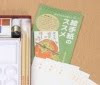
My submission to a call to provide a local community center with hand-powered art fans this summer. These blank bamboo-framed flat fans (uchiwa) come packaged with two adhesive-backed washi cards. I used one of the washi cards to paint the flowers, which I then cut out and pressed against the fan. I wrote the words directly onto the fan. The words are from "Summertime," a popular song from the George Gershwin opera "Porgy and Bess" (1935).

For those who would like to paint their own fans this summer, blank fan kits can be purchased from my Etsy shop while supplies last.


Saturday, May 17, 2014

retro (showa series)

ramen vendor's cart

tofu vendor's cart

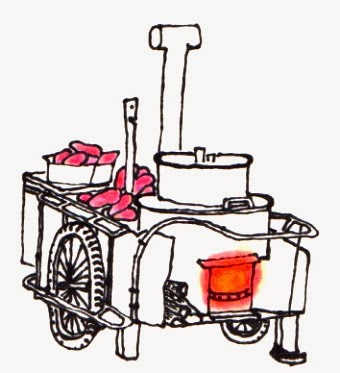
roasted sweet potato vendor's cart

These images are works-in-progress from my Showa Era series. They depict just a few of the many mobile vendors that used to be around when I was a child during Japan's Showa period: 1926~1989, the time of history corresponding to the reign of the Shōwa Emperor, Hirohito. Though they aren't quite extinct, these mobile vendors are much less common than they used to be, and running across one these days is a nostalgic experience.

Over the next few months, I plan to add the goldfish vendor, the wind chime vendor, the bamboo laundry pole vendor, the soba noodle delivery man, and others. Each type of vendor has its own unique sing-song call or musical notes played on a tin horn by which it announces itself, and which draws eager customers into the street to make their purchases.


Thursday, May 15, 2014

barnyard series (ducks)


I'm no expert on ducks or anything, but when I think of the ducks on Old MacDonald's farm, I think of the big white duck and ducklings in the etegami at the top. I've never seen ducks like that on a Japanese farm. The ducks I've seen on Japanese farms are like the smaller, brown kind depicted in the second etegami, and are often kept by rice farmers to eat the bugs in the rice paddies. They are released into the paddies when both the ducks and the rice plants are young, and they grow up together. By the time the paddies are drained and rice harvest season arrives, the ducks, too, are big enough to eat. The big white ducks are called ahiru in Japanese, and the brown ducks are called aigamo. The common word for duck (kamo or gamo) doesn't apply to the white duck. This has always puzzled me. Anyone out there have an explanation for this?

Tuesday, May 13, 2014

barnyard series (lamb)


As I might have mentioned before, one of my goals for this year is to put together a barnyard animal calendar for 2015. I hope to have sheep, cows, goats, ducks, chickens, pigs, and other farm-related animals (mice and owls too, I think) represented. Do you have any suggestions? I need one per month and maybe an extra one for the cover.

This etegami collage is a spin-off of the lamb image I'm working on for the calendar, and will be going to an old friend in Osaka. The words are from Isaiah 40:11 "He tends his flock like a shepherd: He gathers the lambs in his arms and carries them close to his heart."

Monday, May 5, 2014

he's only full of mice


Owl
by X.J. Kennedy

The diet of the owl is not
For delicate digestions.
He goes out on a limb to hoot
Unanswerable questions

And just because he winks like men
Who utter sage advice,
We think him full of wisdom when
He's only full of mice.


Thursday, May 1, 2014

more cross-inspiration

My last post was about the rare pleasure of receiving mailart that is a specific response to an etegami the sender has received from me, a mailart dialogue that I hope to develop further in my next etegami to the same person.

In the meantime, however, I received this art card (above) from Fumiko Koga, a different mailart friend whose signature style is cut-paper art. It, too, is a specific response to an etegami she received from me just a week earlier, one from my whimsical house series (see below). You can see how she converted my image to suit her own medium and sense of whimsy. The accompanying words, too, are a Japanese version of the same Irish blessing that I quoted on my card.

Whether intentional or not, borrowing and lending is always going on among us. The honor is greater, of course, when the borrower recognizes and acknowledges the debt of inspiration. This is not limited to art, but extends to just about everything. Can you think of an example in your life?