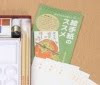
You may remember that I had started a series of etegami depicting
nostalgic scenes and items from Japan's Showa Period (1926–1989). Early Showa was a disturbing time of war and treachery, but by the time I was born, it was an optimistic age in which to grow up.
Former schoolmates of mine, from the international high school we all attended in Tokyo, have been getting together online to plan a major 70s decade reunion to take place in the United States this summer.
I can't attend, but I thought it would be nice to share in the spirit of the reunion by painting and posting etegami that evoke the feel of Japan in the 60s and 70s. That's what the earlier etegami in this series were all about. But I designed this particular etegami for the reunion itself. I'm hoping to print this image on small magnets or postcards, and ask for them to be handed out at the reunion as souvenirs.
The image is that of Koinobori, the carp-shaped windsocks that are flown from flagpoles or
lines stretched across rivers and other open spaces to celebrate Kodomo
no Hi (sometimes called Boy’s Day, but more often called Children’s
Day), a festival held in Japan on May 5th. The carps represent the
parents' desire for their children to grow up strong against adversity,
like the legendary carp who swims against the current of the river and
leaps up waterfalls to magically turn into a dragon. I’ve always thought
the row of carps makes a wonderful image to represent people who are
connected to each other. Like family or classmates.




 Posts
Posts