February 3 is when Japan celebrates
Setsubun (
sometimes called Bean-scattering festival or Bean-Throwing Ceremony). Although the word setsubun means "seasonal division," and there are more than one of those throughout the year, when we talk about the Setsubun festival, we mean the spring setsubun, which is celebrated yearly on February 3. Chinese cultures celebrate this day as New Year's Day according to the lunar calendar, and even in Japan, Spring Setsubun can be considered a sort of New Year-related festival.
On Setsubun, people go through certain rituals that are meant to drive away the bad luck left over from the previous year, and invite in the good luck. The main ritual is called
Mame-maki (bean scattering). Traditionally, we throw roasted soybeans out through the doorway or at someone wearing a horned
Oni (ogre) mask, all the while yelling "
Oni wa soto, fuku wa uchi!" (Out with the ogre/bad luck, In with the good luck). Then, for further luck, each person eats the same number of beans as the number of years they've lived, plus one extra bean.
I do not actively participate in this tradition, but I am rather fond of it, because, like other Japanese festivals and holidays, it keeps me aware of the rhythm of the seasons and assures me, even during the coldest part of our Hokkaido winter, that spring is approaching.... however slowly.
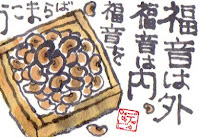
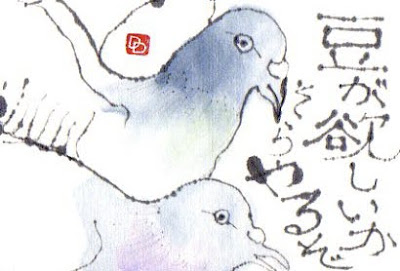
Celebrating seasonal changes is fundamental to Etegami art. So, naturally, I was compelled to mark Setsubun with an etegami (or two, or three, or...). In the two samples posted here, I chose to refer to Setsubun a bit obliquely, and had some fun with word-play. The first etegami quotes a line from a children's song about feeding
mame (beans/peas) to pigeons. The second etegami depicts roasted soybeans in a small wooden measuring box, a widely recognized prop for the bean-scattering ceremony. The accompanying words play with the similarity between the word for "good luck" and the word for "good news/gospel." They translate to "Out with the good news! In with the good news! Scatter the good news!"

 Today's etegami is a simple persimmon accompanied by writing that says "ka
ki ku ke konnichi wa." I played with the k syllables in the Japanese
syllabary. "kaki" means persimmon. And "konnichi wa" means hello. No deep meaning. Just a cheerful greeting for any day of the year, but especially late fall and winter.
Today's etegami is a simple persimmon accompanied by writing that says "ka
ki ku ke konnichi wa." I played with the k syllables in the Japanese
syllabary. "kaki" means persimmon. And "konnichi wa" means hello. No deep meaning. Just a cheerful greeting for any day of the year, but especially late fall and winter.


 Posts
Posts