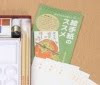
I had noticed the first photo in the January issue of Gekkan Etegami (a monthly magazine published by the Japan Etegami Society), but it wasn't until I saw the February and March issues that I realized the magazine was doing a monthly serial featuring etegami by the artist known as "Grandma Chieko" (Chieko Matsuo).
These etegami are part of a collection that was published in 2004 under the title Osana Asobi (the games of childhood). The title refers to Matsuo's own childhood in rural Nagano prefecture, and the games are ones that most children today-- glued as they are to their electronic gadgets-- have probably never played.
 The etegami in the three photos shown here depict indoor games played during the long, cold winters of northern Japan. Photo#1 depicts Fukuwarai, which is similar in concept to Pin the Tail on the Donkey. Photo#2 depicts Mikan Hiki (fishing for tangerines). And Photo#3 depicts a scattering of toys and tools that include crayons, a paper balloon, cloth and paper dolls, o-tedama (bean bags for juggling), a paddle and shuttlecock for playing hanetsuki, colored paper for origami, and my own favorite: o-hajiki-- the flat-ish glass "marbles" used by girls. "I still have these treasures," it says on the card.
Matsuo's style is to fill the card with detail and use jillions of colors. It feels a bit cluttered compared to the style endorsed by Koike, the "father" of the modern etegami movement. But her etegami are warm and cozy, and they give me a feeling of security. It must be because she and I are both children of the Showa era. The youth of today were born in the Heisei era. I wonder what images make them feel happy and safe. Smart phones and keyboards? It's an interesting thought.


 Posts
Posts