Showing posts with label ainu folk tales. Show all posts

Tuesday, July 15, 2014

the ainu and the fox


Another etegami from my fox series, this time with a quote from The Ainu And The Fox, an Ainu folk tale rewritten for children by Kayano Shigeru and translated into English by me. To learn more about this book, read this post on my Project Uepeker blog.

Monday, December 12, 2011

tomo anthology to assist teens


TOMO, an anthology of short stories with particular relevance to teens, will be released this coming March from Stone Bridge Press. Its aim is to bring Japanese stories to readers worldwide, and in doing so, to help support young people affected or displaced by the March 11, 2011 Japan earthquake and tsunami. Proceeds from the sales of this book will go directly toward long-term relief efforts for teens in northeast Japan, the area most affected by the disasters.

My translation of the Ainu folktale, "Where the Silver Droplets Fall," accompanied by two simple etegami-style drawings, is included in this book. As one of the contributors to the anthology, I was interviewed on the TOMO blog. In the interview, I share a bit of my personal background and what led to my becoming a translator of Ainu folklore. But more importantly, it gives a glimpse into the life of Chiri Yukie, one Ainu teenager who struggled to value herself and her cultural heritage, at a time when both were despised by mainstream society
. By the time she died of heart failure at the tender age of nineteen, she had become a forerunner of a movement to save her people's oral tradition from oblivion. Click here to read the interview.

Thursday, September 8, 2011

sketchbook project 2012 (fourth tale)


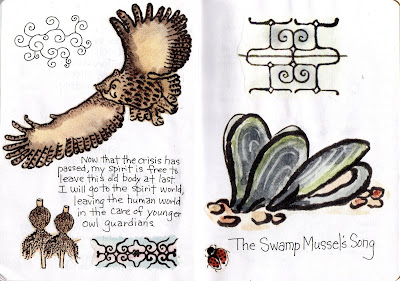
My last Ainu folk tale The Swamp Mussel's Song, the front & back covers, and misc. pages. It's all done and ready to mail. You can click through the whole thing on my Art House Co-op profile page.

Sunday, August 7, 2011

sketchbook project 2012 (third tale)


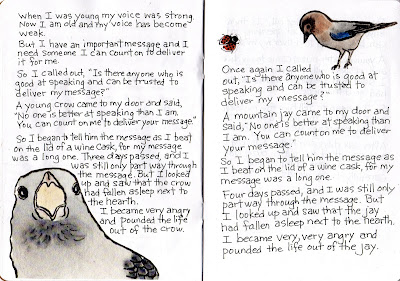
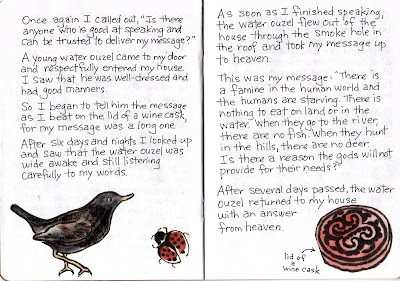
The Ainu word that usually gets translated as "god" is kamuy, and it basically applies to all things other than humans (ainu). This includes both living and non-living things. In the traditional Ainu worldview, kamuy spirits normally live in kamuy moshir (the land where the kamuy dwell), living just as humans do in ainu moshir (the land where the humans dwell). But once in a while, the kamuy borrow the forms of animals, plants, tools, and so forth, to visit the human world. And when they are freed from those forms (usually when their form dies or is used up in service to the humans) their spirits return to the land where the kamuy dwell, until such time as they desire to visit the human world again.

If the kamuy are not treated with honor during their visit to the human world, they are less likely to come for another visit. The forms which kamuy leave behind when they return to their own world are the food and other necessities that humans require for life. A steady supply of these necessities depends on humans showing proper respect and thankfulness (through various rituals) to ensure that the kamuy will make regular visits to the human world.

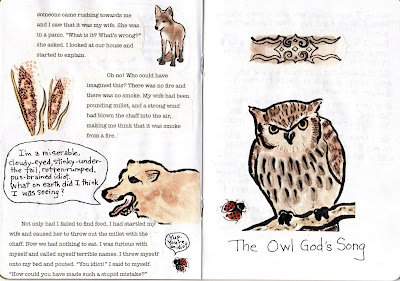
So, while there are many, many kamuy, some kamuy have higher status than others. The Owl Kamuy takes the form of the Blakiston's Fish Owl, probably the largest species of owl in the world. It is the guardian of the human village and has very high status. That's why I kept the word "god" in the title of The Owl God's Song, even though I omitted it in the other titles as being irrelevant and potentially confusing.

Wednesday, July 27, 2011

sketchbook project 2012 (first tale)


I wrote about what I had in mind to do for the Sketchbook Project 2012 in an earlier post, but I find that as my sketchbook takes shape, I've had to make minor adjustments to my original concept. It is, however, taking shape, and that's the important thing. I am posting the first of the four yukar tales ("the river otter's song") that make up my new project. I hope it grabs your interest enough that you will come back to see more. :p

Wednesday, June 1, 2011

the sketchbook project 2012

Some of you may remember that I participated in The Sketchbook Project last year, and that I filled my sketchbook with etegami illustrating the roughly 50 proverbs and sayings that resulted in my Japanese Proverbs series.

The Sketchbook Project was so much fun and satisfying to participate in, that I decided to try it again this year. There are various rules you have to follow, and one of these is that everyone has to submit their artwork in the same type of sketchbook-- a small-ish, blank notebook that gets sent out to all registrants by the Sketchbook Project headquarters.

This year I will be filling the sketchbook with my illustrated translations of Ainu folk tales. The Ainu are the indigenous people of northern Japan, and if you've ever checked out my Project Uepeker blog, you know that I'm part of a team that has been working for over a decade to make Ainu oral literature accessible to English readers.

The etegami posted here is one of my illustrations for a folk tale called A Song Sung by the Otter God. I still have to decide what words to put on it. Probably Ainu words taken from the story. The English translation of the story will fill up all the space in the notebook that the illustrations don't fill up.

I plan to post more samples from my sketchbook as it takes shape. I hope it will be fun for you to follow along.

Click the Sketchbook Project banner in the sidebar to learn more about it. Maybe you'll decide you want to participate too. : )