Wednesday, April 6, 2016

time, time, time, see what's become of me


This etegami is from my "Life Between Cultures" art journal. As usual, I've tried to incorporate a kind of wordplay that gives the combination of words and image more than one level of meaning.

The image was inspired by the Japanese legend of Urashima Taro, a young fisherman who rescues a turtle and accepts an invitation to visit the palace under the sea where the dragon god lives. There he is lavishly entertained for three days, until he asks to be allowed to return to his village to check on his aged mother. They regretfully let him go, and the dragon god's daughter gives him a mysterious box called a tamatebako to protect him from harm, but which must never, ever be opened.

Taro takes the box and is escorted back to the shore of his village. But he finds that everything has changed. His home, his mother, and everyone he used to know are gone. It appears that 300 years have passed on land while he was at the palace under the sea. Bewildered and grieving, he absent-mindedly opens the tamatebako. A cloud of white smoke bursts out of it, and suddenly Taro is turned into an old, old man with a long white beard and bent back. I find it a sad and puzzling story.


Wednesday, March 30, 2016

the museum walls are waiting


This invitation to submit mailart arrived in today's mail. I receive a lot of unsolicited invitations, and I don't often post them if they are from people I don't know-- like this one. But the words "museum walls are waiting..." caught my fancy, and it is a Japan-based mailart call, so I am sharing it with my readers. As you can see, this is not a call for etegami, but for mailart of any format, size, material, or theme. And entries will be displayed in a museum. Grab the ball and run with it-- if you are so inclined. It could be fun.

Friday, March 4, 2016

japanese white-eye


Yes, here in Sapporo we are still buried in snow. But temperatures are rising, and the towering, dingy-white piles are expected to start shrinking fast. Time to paint the Japanese White-eye.  This was custom-designed for a women's group that is holding their annual retreat this weekend.

Thursday, February 25, 2016

pranks on cats


You may be familiar with the videos making the rounds of SNS, that show a cat getting scared out of its wits when it becomes aware of a cucumber deliberately placed in its blind spot by some prankster.  I laughed the first time I saw one of these videos, but not after the second or the third or the twentieth. It's really been bothering me.

Monday, February 15, 2016

more etegami inspiration from books


My husband picked up a couple of books by William Alexander from our local library last week. He had never heard of the author, but there was something (the title? the cover? the blurb on the back?) that gave him a feeling these were my kind of books. He was right. The books are targeted to ages 8~12, so of course they were perfect for me. (This is where you either laugh out loud because you think I'm joking, or you just smile wisely.)

The titles of these two books are Ghoulish Song and Goblin Secrets, and, as the titles suggest, they are fantasy books set in and among a time/place/people where magic seems to happen, and even to belong, but mostly when people aren't paying attention.  I read them both in no time at all, but there were two lines in Goblin Secrets that stuck in my mind and begged to be expressed in etegami form.

The first comes from this paragraph: Rownie walked in daylight with a fox face over his own, and some people couldn't see him at all. He was hiding and proclaiming himself, both at once. He didn't know how this could possibly work, and he didn't want to think about it too much in case it stopped working, so he just kept moving. He let the fox mask show him how to move.

The whole section about the fox mask intrigued me because foxes, and even fox masks, have a solid place in Japanese mythology and culture, in a way that gave this story a nostalgic feel. I felt it could lead to an etegami that fit in well with my " life between cultures" -themed art journal, so I gave it a try.


The other line that engaged my imagination was this one describing the marketplace along the riverbank: Another barge-stall showed off small and cunning devices that did useless things beautifully. Don't you just love the combination of those words? And I've always loved cunning works of art that look like they ought to have some practical use, but really exist just to delight people like me.

Well, that was fun. Now to find some more cool stuff to read.


Tuesday, February 9, 2016

washi cardbooks for etegami journaling


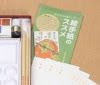
Since I began posting my baby steps in art journaling, I've received a lot of queries about the washi card booklets I use, so I thought I'd take this chance to introduce them in greater detail than I can on Facebook or by email.  The Kuretake postcard book shown here contains 20 pages of medium-bleed washi cards. Perforated so that they can be removed, stamped, and mailed off, of course. But that's not all. In addition to the perforations at the top, it has perforations on the sides and bottom, so that after you paint your etegami, you can "crop" it down to the standard postcard dimensions, giving your etegami greater focus. You do have to be careful not to let anything important-- like the words-- stray into the margin area that will be lost when the card is cropped.


If you've read my book A Beginner's Guide to Etegami, you know that orthodox procedure for etegami is to paint freely past the border of your card and onto a large piece of paper that you've placed under the card to take the overflow. That is how you get the cropped look without actually cropping the etegami. This  card book gives you an easy way to cheat, especially if you're having a hard time allowing yourself the freedom to paint beyond the border of your standard-sized postcard. I have no hesitation about painting with abandon and spreading my image beyond the borders of my cards, so I'm not sure how I feel about this easy alternative.  But if you struggle against a tendency to draw tight images in the middle of your card, this may be one way to give a freer look to your work. I bought the Kuretake booklet, so I'll use it eventually.

The next two photos show the card book I am currently using. Like the Kuretake card book shown above, this Maruman card book has 20 cards perforated at the top for easy removal. The bleed quality is about the same as the Kuretake card book. The Maruman book is smaller because it is already postcard-sized, without the removable margins that the Kuretake card book has. So it's easier to slip into your bag or pocket if you plan to paint in it while traveling or just rambling in the neighborhood.

I ordered both the Kuretake and the Maruman from Amazon Japan, and have not done any research to see if it is also available outside of Japan or from other online vendors. However, I did receive a comment from a beginning etegami artist who found the Maruman card books at some kind of "super sale" in the US ---perhaps at a major stationery goods supplier? Anyway, judging by the English writing on the cover of both brands, chances are good you can find them outside of Japan.


Monday, February 8, 2016

life between cutures


I've decided to start on a second art journal with a different theme from the first one. On days when I don't have inspiration for one, I can paint something in the other. In fact, I may decide to have three or four journals going on at the same time. This second art journal will probably be on the theme of "life between cultures," a subject close to my heart and experience. But that theme may undergo slight changes as the art emerges.

Here we have a daruma doll representing one culture (Japan), and a matrioshka doll representing another (Russia). It really doesn't matter what countries they represent, just that they are different.  Though we hold passports from the same nation,  my husband and I were born and raised in different countries with vastly different cultures, so it might as well be called an international marriage.

But it isn't marriage that I want to depict in this art journal. What I want to depict is the experience of being part of, and yet not being part of, the land and culture in which one is physically placed. I bet many of you are in the same situation. Maybe you have depicted that in art, or maybe you would like to. If you do, please share it with me.