Showing posts with label matsuo basho. Show all posts

Tuesday, June 16, 2015

flower salad

My father-in-law is an avid hiker, bird watcher, and admirer of wildflowers. He often sends me photographs of colorful flowers to inspire my etegami.

His birthday is coming up, so I asked him if he had any special requests, or did he want to take a gamble and let me surprise him. He sent me more flower photos and then added that he wouldn't mind taking a gamble.

I did make an attempt at the straight-forward approach-- using his photos as a model for painting wildflowers in their natural setting. But mischief, that constant companion of my heart, raised its tousled head, and the next thing I knew, I was painting flowers as food. As in food for the stomach, not food for the soul.

The words in the etegami shown above say o-hanami yori hanami (preferring flower-tasting to flower-viewing), a play on the same-sounding words hanami (flower-viewing) and hanami (flower-tasting). Actually, I made up the second expression by forcing together the word for flower and the word for flavor. I just can't resist wordplay, and Japanese is the perfect language for it.

The words on the etegami shown below quote a poem by haiku master Matsuo Basho. He was reflecting on fate and the fragility of life. Only, it wasn't a horse that ate the flowers. It was yours truly.  I wonder if my father-in-law will think that his gamble paid off.


Thursday, May 28, 2015

rainy season haiku


While Hokkaido looks forward eagerly to a typically mild, sunny, fragrant, bright green, sweet-breezy June, the rest of Japan has entered-- or is about to enter-- the pre-summer rainy season called tsuyu, often translated literally as "plum rains."

The mugginess of tsuyu can be quite miserable-- one of those times of the year when I wonder out loud how anyone would choose to live anywhere other than tsuyu-less Hokkaido. (In just a few months, the Hokkaido winter will arrive with a powerful reply to that question.)

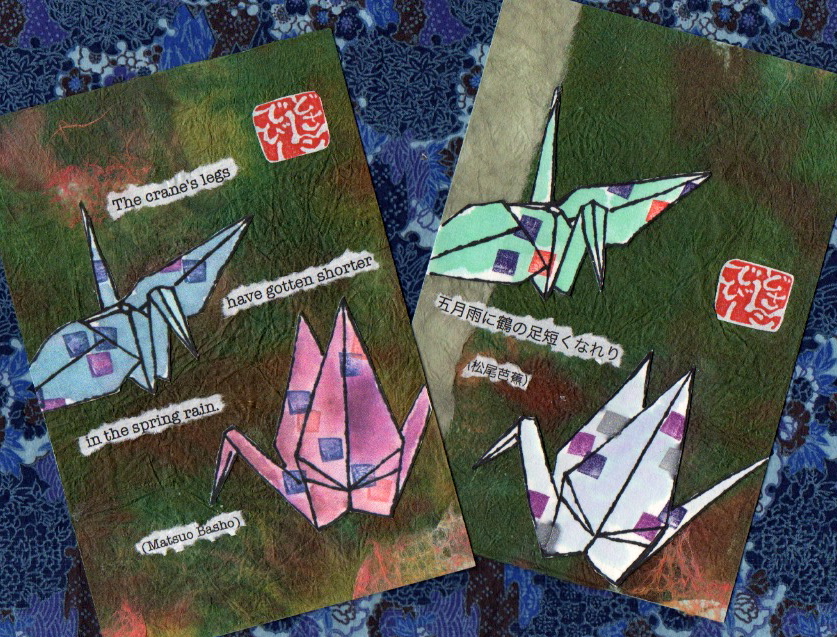
Well, anyway, I've been working on tsuyu-related etegami to encourage my friends who have to endure the rainy season. I started with a couple of etegami collages that recombine parts of previous etegami that may seem familiar to you.

Both the Japanese version and the English version quote a gently humorous haiku by Matsuo Basho: The crane's legs/have gotten shorter/in the spring rain (translated by Robert Hass). It's easy to imagine the cranes standing in the water, their long, skinny legs appearing shorter and shorter, as the level of the river, stream or lake rises higher and higher. The folded paper cranes, being legless, are kind of perfect for this haiku, don't you think?


Friday, August 31, 2012

illustration friday (identical)

Some of you may have seen this etegami before. I considered it a "failure" when I first painted it, but it grew on me with the passing of time, and now it's one of my favorites. The accompanying words are a haiku by the wandering poet Matsuo Basho (1644-1694). Don't imitate me. It's as boring as two halves of a melon.

Friday, December 16, 2011

illustration friday (sink)


Some recent summer-themed etegami from Carole Marshall "down-under" in Australia, inspired me to turn one of my earlier cicada etegami into a collage for this week's Illustration Friday post. The accompanying words are my translation of a haiku by Matsuo Basho (1644 – 1694).

Sunday, November 6, 2011

illustration friday (stripes)

One of the many things I love about Autumn is the shapes of the clouds in the sky. The other day I looked up at a sky that was striped from edge to edge.

This is a collage made from three different kinds of washi paper. The accompanying haiku by the itinerant poet Matsuo Basho, reminds me that being able to see the moon (or whatever you've set your gaze upon) --clearly and all the time-- isn’t necessarily the only way to enjoy it— or life.

Monday, March 7, 2011

two halves of a melon


This is a second etegami I did for Illustration Friday on the theme of "warning." The accompanying words are a haiku by the wandering poet Matsuo Basho (1644-1694). The English version I used for this piece is Robert Haas's translation. Don't imitate me. It's as boring as two halves of a melon.

Monday, January 11, 2010

inspired by haiku


My etegami are often accompanied by fragments of poetry. No, not my own. Poetry that other people have written. Sometimes the drawing will bring a poem to mind. Other times a poem I've read or heard will compel me to express it in etegami. This is especially true of haiku poetry, and even more true of the haiku of Matsuo Basho (1644-1694), the internationally renowned wandering poet of Japan. When I drew this closeup of a single white flower, it was his haiku on the sound of the temple bell that came to mind. Maybe the numerous yellow stamens reminded me of the knob-ended sticks that are used for hitting some kinds of gongs or temple bells. Whatever it was that went through my subconscious thoughts, the simplicity of the image and the simplicity of haiku seemed to be a perfect match. Try pairing an etegami drawing with one of your favorite haiku, or compose one of your own for the purpose.