Thursday, July 30, 2009

detach yourself, sense life


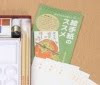
When the August issue of Etegami Magazine arrived a few days ago, I realized I had forgotten to blog about the July issue. But I am forced to press ahead. There are so many interesting things to draw these days, and so many topics I still want to write about on the subject of etegami. The title of the August issue was "Sense Life and Draw with Detachment." [I'm still not clear on what I'm supposed to be detached from. Distractions? Expectations? The desire to excel?] But I suppose another way of translating it would be: Be focused.

The drawings that drew my attention were the ones you would expect in this season of growing things. Flowers in full bloom and newly harvested vegetables. Yes, I could sense the life in these things. They were fairly bursting with it. Then I looked through the pictures again. Drawings of home life. A school bag tossed in the corner of the room. A tiny girl carrying her baby sister (almost as big as she is) on her back. A pair of knitting needles and a half-finished woolen scarf. They were more subtle, and I had to listen harder, but I sensed life in them as well-- maybe more powerfully than the drawings of the flowers and summer harvest. It was an intriguing discovery. The evidence of life is everywhere, not just in the most obvious places. In fact, the August issue announced an etegami exhibit on the subject of war memories. Life was powerfully present in these drawings too. Even in the burning house and the white cloth-wrapped cremation urn. I'll tell you more about this exhibit in my next post.

Sunday, July 19, 2009

my strawberry diary


Four months ago, even before our long winter was over, a strawberry seedling was delivered to my door. It was my first hesitant step toward raising something edible in my garden. I decided to keep an etegami diary of the plant's growth, and recorded the six main stages that I was able to observe. I drew it on the first day it arrived, in its tiny vinyl cup. A few weeks later, I moved it into a large planter and set it outdoors. But then the temperature plummeted and it snowed off and on for many days. I thought I had lost my strawberry plant. It was looking spindly, and the leaves were orange and brown-tinged. It turned out that the earliest leaves were just naturally withering away, and the leaves that replaced the first growth were lush and vigorous. A little later, pretty white blossoms appeared, followed by hard knobby green fruit. More waiting, and the fruit grew plump and red and ready to be picked. On the final day of my diary, I picked the fruit and used it in making ichigo-daifuku, an-filled (sweet bean jam) dumplings made of glutenous mochi rice, with my freshly picked strawberries in the center of each dumpling. My strawberry plant had fulfilled her destiny. And my strawberry diary had come to its end. Why don't you give it a try too? Record the growth of something dear to you with etegami.

Sunday, July 12, 2009

etegami and the civic spirit


In June I had the honor of guest-posting on The Nihon Sun, an endlessly informative website on all aspects of Japanese culture and life in Japan. The theme of my post, of course, was etegami. I was asked to include a tie-in to Tokyo's bid for the 2016 Olympics, which was not at all a difficult thing to do, since etegami is one of the means by which Tokyo, and many other municipalities, raise public interest in civic events. Please visit my post on The Nihon Sun for details.

The photo attached above is from the annual Etegami Contest sponsored by a Hiroshima-based writing brush maker, the Fude-no-sato-kobo. Using etegami to promote a writing brush company may seem an obvious ploy, but what about a hot springs? Last year Gero Onsen in Gifu prefecture called for submissions of etegami related to the spa bathing experience. The winning etegami are displayed on this page. Some of the shops in this spa town even had their shutters painted with images of the winning etegami, a charming idea for entertaining spa guests even when the shops are closed for business.

The ways that regions, organizations, and businesses use the grass-roots popularity of etegami to fan the flames of public interest increase with each passing year. Consider the power of etegami the next time you have something you want to promote.

Sunday, July 5, 2009

let it bleed


When adding color to my drawing, I usually avoid filling up the space inside the lines. You may remember that I wrote about this in the post beauty in blank spaces. Some subjects that are very detailed or very thin, however, actually benefit from having color bleed beyond the borders. A single, thin, asparagus spear for example. Or a bean sprout. Or a cluster of very tiny flowers. One day I decided to experiment and see how much I could get the colors to bleed. Before I drew anything, I brushed plain water over the whole card. Then I quickly sketched these Gerber daisies and painted in the color before the card could dry out. I also wrote the letters while the card was still wet. Bold, sturdy, Gerber daisies were probably not the best choice for this experiment, but I did learn something from the result. I have a feel now for how much water my cards absorb and how this affects the application of both color and sumi ink. In the future, when I come across a subject that begs for this treatment, I'll know what to do.

Sunday, June 21, 2009

drawing hydrangeas out of season


Here's the hydrangea etegami that I mentioned in my previous post. It depicts the hydrangea in my own yard, late in the year, just before the first snowfall in November. Hydrangea is a plant associated with tsuyu, the rainy season. Famous paintings and woodblock prints often show hydrangea in the rain, lush and dewy-looking. Those familiar with the climate of Japan, know that the rainy season is now (June~July) just about everywhere in Japan--except Hokkaido. We don't really have a rainy season, at least not like the rest of Japan does. And flowers don't even form on our hydrangea bushes until mid to late July. They continue to bloom until late fall. As winter approaches, the blossoms dry on the branches, and as they dry, their color undergoes subtle changes. Ours start out blue, but as winter approaches, some of the blossoms take on purplish and greenish hues. The leaves too, take on the autumnal tints of orange and brown with swatches of red. When the air begins to smell like imminent snowfall, I cut the stems of the flowering branches, bring them inside, and hang them upside down from a clothesline in the laundry room. When the stems and the blossoms are completely stiff and dry, I arrange them in a large ceramic pot to display during our long winter.

In my second (and final) year of participating in a post office-sponsored etegami group, we were given long cards to try our hands at long-ish subject matter. I drew hydrangea for the first time, and was pleased enough with the result to submit it for the annual post office etegami exhibit. I received some interesting feedback from my fellow etegami artists. (1) I used too many colors (2) I didn't leave enough uncolored space (3) hydrangea is a kigo (seasonal word used in poetry) for the rainy season, and is not usually depicted in art outside of that season.

I was a fledgling etegami artist, and hadn't yet grasped the etegami ideal of simplicity in form and color, or the technique of moving the ink brush slowly enough to make the lines wobble. After all these years, I still struggle against using too many colors. On the other hand, maybe I'm not trying very hard to tame that tendency. I guess deep down inside, I'm satisfied with the way I use color. Same with drawing subjects outside the seasons with which they are associated. I'm not going to draw a strawberry in the wintertime. But since the hydrangea is actually there in my yard in November, blooming and changing in subtle ways, I figure it's all right to try to capture it in an etegami, even if it isn't the rainy season. Am I being rebellious? I don't know. But there are almost as many etegami styles as there are etegami artists, even in Japan. Besides, I draw for my own pleasure. And so should you.

Thursday, June 18, 2009

etegami and the postal service


Years ago, when I first took up etegami, I was a member of an etegami class that was sponsored by the Japan Postal Service. The JPS sponsors many such classes all over the country, and it makes sense when you realize that etegami artists can be depended on to purchase many, many postage stamps. Post offices all over the country hold etegami exhibits at least once a year, and people who belong to a JPS-sponsored class are strongly encouraged to submit samples of their work. The attached photo was taken at one such post office exhibit. I googled "post office" and "etegami" and discovered that just about every local post office had a website with a page about the etegami classes they sponsor, as well as photos from their exhibits.

The first year, I tried to get out of submitting anything. Although I was secretly pleased with my progress, my ego couldn't take being compared to other, more seasoned, artists. I did eventually succumb to pressure by submitting an etegami of an apple. I no longer have it, and I never made a copy. The second year, I submitted two etegami. One was of hydrangea in the fall. I was actually quite proud of it, but the comments it drew from my group leader and other etegami artists gave me an education that has stuck with me. I will tell you about it in my next post.

Friday, June 12, 2009

extending a subject over more than one card


Here is a series of three etegami I drew on the subject of tsukushi, the fertile stems of the Equisetum arvense, commonly known as the Field Horsetail or Common Horsetail. Tsukushi are one of the first plants to come up in the spring, but they soon make way for the taller, bushier, greener, sterile stems known in Japan as sugina. Both the fertile and sterile stems have jointed segments that remind me a little of bamboo. They grow profusely at the edges of our garden wall, especially on the public side of the wall where neighbors consider them an eyesore and gently hint that I should be pulling them out. But I find tsukushi to be a charming plant. I like their shape. I like how they grow in clusters of mixed heights and mixed tones of brown, as though they were a close and happy family that enjoyed each other's company. They are edible too, though not exactly full of flavor. I've heard people say tsukushi are only palatable when they first come up, when they are at their most succulent stage. But I kind of like them when they've gotten a bit dry, when their tufted "heads" get a wee bit crunchy. At least once each spring, I harvest a handful of tsukushi and toss them into a lightly oiled frying pan with boiled spaghetti noodles for a nutty accent, or simmer them in a soy-based sauce and fold them into an omelet. Oh dear, here I am again, going on and on about eating the subjects of my drawings. Getting back to the drawing itself: I happened to place three of the tsukushi etegami side by side, and was pleasantly surprised by the way the "field" of tsukushi spread out in either direction. It is not uncommon for etegami artists to place two (or more) cards side by side, extending a single subject over both cards. Usually something long, like a whole daikon radish or corn-on-the-cob. Each card will bear only a segment of the whole drawing. The cards can be mailed off to different recipients, or they can be mailed to the same recipient staggered over a period of time. I didn't have that in mind when I drew my tsukushi, but I accidentally came close to producing just that sort of etegami. Etegami is meant to be mailed-- not hoarded. But if I were to frame these three cards in a hinged three-part frame, it would qualify as a triptych, wouldn't it? Then again, that could lead to visions of grandeur. I like to say that etegami art is not Art with a capital A. It's of the people, to be enjoyed as part of everyday life. The accompanying words? Oh yes, the letters says "mure," which means flock (or band, or troop, or cluster). I drew it for an elderly woman in my church. A dear sweet lady who is part of the same flock as I am.